
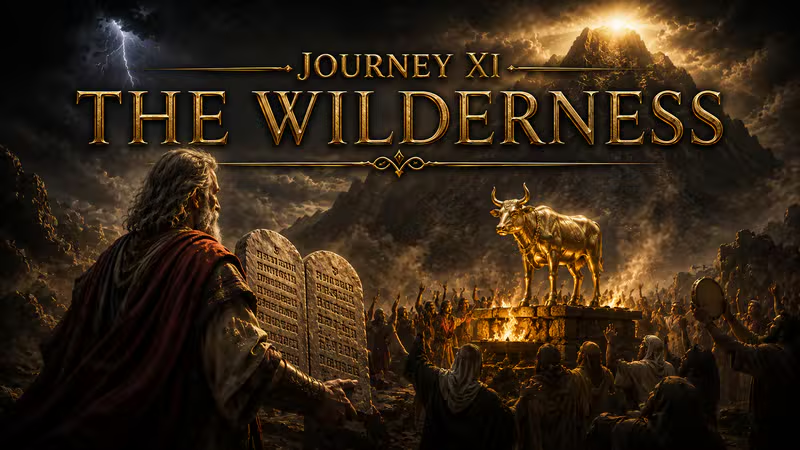
Journey XI
The Wilderness
Sinai, the Law, the Tabernacle, manna, the golden calf, and forty years in the wilderness. A journey through testing, rebellion, provision, and the presence of God.
Between Egypt and the Promised Land
Israel had been delivered from Egypt.
Pharaoh's power was broken.
The sea had opened.
The people had crossed on dry ground.
Behind them lay slavery.
Before them lay the land God had promised.
It might seem that the hardest part of the journey was already over.
But between Egypt and the Promised Land stood something else:
the wilderness.
And there God would reveal not only who He was—
but what was still hidden in the hearts of His people.
Delivered — But Not Yet Home
The Exodus was an extraordinary act of deliverance.
Yet God did not lead Israel directly from Egypt into Canaan.
Instead, He led them into the wilderness.
"And the LORD went before them by day in a pillar of cloud, to lead them along the way, and by night in a pillar of fire to give them light."
— Exodus 13:21
Israel was no longer guided by Pharaoh.
They were guided by the presence of God.
Cloud by day.
Fire by night.
The wilderness therefore begins with a remarkable picture:
a people who do not know the road, following a God who does.
The First Tests
Freedom immediately brought new challenges.
There was no Egyptian storehouse in the wilderness.
No familiar supply of food.
No predictable source of water.
At Marah the water was bitter.
The people complained.
God made the water drinkable.
Later they became hungry.
Again they complained.
And then something appeared on the ground that they had never seen before.
They asked:
"What is it?"
In Hebrew:
Man hu?
From this came the name:
manna.
"Then the LORD said to Moses, 'Behold, I am about to rain bread from heaven for you.'"
— Exodus 16:4
Every morning, except the Sabbath, the provision appeared.
They could gather what they needed.
But they could not control tomorrow.
God was teaching Israel something deeper than how to survive in a desert.
He was teaching them:
dependence.
Day after day.
Meal after meal.
Water from the Rock
Then came thirst.
At Rephidim there was no water.
The people argued with Moses.
Again the question arose:
Had God brought them into the wilderness only to let them die?
God commanded Moses to strike the rock.
Water came out.
— Exodus 17:1–7
Much later, the New Testament looks back upon this event and adds an extraordinary spiritual connection:
"And that Rock was Christ."
— 1 Corinthians 10:4
Paul therefore sees the wilderness story as more than ancient history.
The events carried lessons for those who would come afterward.
Provision in the wilderness pointed beyond itself.
Sinai
Then Israel arrived at Mount Sinai.
The mountain changed everything.
Thunder.
Lightning.
A thick cloud.
The sound of a trumpet.
Smoke rising from the mountain.
The earth trembling.
And God descended upon Sinai.
— Exodus 19
The God who had defeated Egypt was not merely leading Israel somewhere.
He was establishing a covenant with them.
"You shall be to Me a kingdom of priests and a holy nation."
— Exodus 19:6
This was not merely the story of rescued slaves.
God was forming a people.
The Ten Commandments
At Sinai God gave Israel His commandments.
The opening words are important.
God does not begin by saying:
Obey Me so that I will rescue you.
He begins by reminding them that He already has.
"I am the LORD your God, who brought you out of the land of Egypt, out of the house of slavery."
— Exodus 20:2
Deliverance came first.
Then instruction.
The Law showed Israel how a people belonging to God were to live:
toward God,
toward one another,
toward family,
toward life,
toward truth,
toward property,
and even toward the desires of the heart.
The wilderness was becoming a classroom.
But Below the Mountain...
Something disturbing was happening.
Moses remained on Sinai.
Days passed.
The people became impatient.
They approached Aaron and demanded:
"Make us gods who shall go before us."
— Exodus 32:1
Gold was collected.
It was melted.
And a golden calf was made.
Only a short time after witnessing the defeat of Egypt's gods and hearing God's covenant at Sinai, Israel turned toward an idol.
The contrast is almost shocking.
Above the mountain:
Moses receives God's covenant.
Below the mountain:
the people break it.
The wilderness exposes a recurring biblical problem:
A person can leave Egypt physically—
while still carrying Egypt within the heart.
Moses Stands in the Gap
God's judgment threatened the people.
But Moses interceded.
He pleaded for Israel.
He appealed to God's promises to Abraham, Isaac, and Jacob.
— Exodus 32:11–14
Here Moses begins to appear not merely as a leader but as an intercessor—
standing between judgment and the people.
This pattern will return again and again.
Israel rebels.
Judgment approaches.
Someone intercedes.
Mercy follows.
It is one of the great patterns running through Scripture.
"Show Me Your Glory"
After the catastrophe of the golden calf, Moses asked God for something extraordinary:
"Please show me Your glory."
— Exodus 33:18
God placed Moses in the cleft of a rock.
His full glory could not be seen directly.
Yet God passed by.
Then God proclaimed His own character:
"The LORD, the LORD, a God merciful and gracious, slow to anger, and abounding in steadfast love and faithfulness."
— Exodus 34:6
This may be one of the most important moments of the entire wilderness story.
Israel had failed.
But when Moses asked to know God's glory, God revealed His character.
Merciful.
Gracious.
Patient.
Faithful.
The wilderness reveals human rebellion.
But even more importantly—
it reveals who God is in the midst of it.
The Tabernacle
Then comes one of the strangest and most beautiful developments of the journey.
God commanded Israel to build a sanctuary.
"And let them make Me a sanctuary, that I may dwell in their midst."
— Exodus 25:8
Think about what this means.
The Creator of heaven and earth chooses to place His dwelling—
in the middle of a wandering camp.
The Tabernacle stood at the heart of Israel.
Around it were the tribes.
Within it were sacred spaces:
the courtyard
the altar
the Holy Place
the Most Holy Place
And within the Most Holy Place stood the Ark of the Covenant.
Above it:
the mercy seat.
The Tabernacle became a visible declaration:
God desires to dwell among His people.
The Presence Enters
When the Tabernacle was completed, something happened.
"Then the cloud covered the tent of meeting, and the glory of the LORD filled the tabernacle."
— Exodus 40:34
The story had begun with God's presence appearing before Israel as cloud and fire.
Now His glory rested in the very center of their camp.
When the cloud moved—
Israel moved.
When the cloud remained—
Israel remained.
Their journey was literally determined by the presence of God.
The Edge of the Promise
Eventually Israel reached the border of Canaan.
Twelve spies entered the land.
They returned with extraordinary evidence of its abundance.
But they also brought frightening news.
The cities were fortified.
And the inhabitants appeared powerful.
Ten spies focused upon the danger.
Joshua and Caleb focused upon God's promise.
Then comes one of the most memorable statements in the wilderness narrative:
"We seemed to ourselves like grasshoppers."
— Numbers 13:33
Notice where the fear had reached.
Not merely:
They are giants.
But:
We are small.
Fear had changed how Israel saw itself.
Two Voices
Joshua and Caleb saw the same land.
The same cities.
The same enemies.
But reached a completely different conclusion.
"The LORD is with us; do not fear them."
— Numbers 14:9
The difference was not what their eyes saw.
The difference was whom they trusted.
Israel refused to enter.
And the generation that had left Egypt would wander for forty years.
A journey that could have led quickly toward the promise became a generation-long wilderness.
Forty Years
The wilderness became the place where an old generation passed away and a new generation was prepared.
Moses later explained its purpose:
"And you shall remember the whole way that the LORD your God has led you these forty years in the wilderness, that He might humble you, testing you to know what was in your heart."
— Deuteronomy 8:2
That sentence unlocks much of Journey XI.
The wilderness was not empty space between two important locations.
The wilderness itself was part of the story.
It revealed what prosperity could conceal.
Hunger revealed trust.
Thirst revealed trust.
Waiting revealed trust.
Fear revealed trust.
Power revealed trust.
The wilderness exposed the heart.
The Serpents and the Bronze Serpent
Near the end of the journey, Israel rebelled again.
Venomous serpents came among the people.
Many were bitten.
The people confessed their sin and asked Moses to pray.
God told Moses to make a bronze serpent and raise it upon a pole.
Those who looked upon it lived.
— Numbers 21:4–9
Centuries later Jesus Himself returned to this strange wilderness event:
"As Moses lifted up the serpent in the wilderness, so must the Son of Man be lifted up."
— John 3:14
Suddenly an event in Numbers reaches forward toward the Gospel.
A dying person looked toward what God had provided—
and lived.
Jesus takes that image and points it toward Himself.
Manna — And the Bread of Life
Jesus also returned to the story of manna.
Israel's ancestors had eaten bread in the wilderness.
But Jesus said:
"I am the bread of life."
— John 6:35
The wilderness provision therefore becomes another biblical pattern.
Manna sustained physical life.
Christ offers something greater.
The wilderness begins to echo forward.
Bread.
Water.
Rock.
Tabernacle.
Sacrifice.
Intercession.
The lifted serpent.
God dwelling among His people.
The pieces begin to connect.
The Wilderness Pattern
And then the New Testament gives us one more remarkable scene.
Jesus is baptized.
The Spirit descends upon Him.
And immediately afterward—
He goes into the wilderness.
For forty days.
Israel spent forty years being tested.
Jesus spends forty days being tested.
Israel repeatedly failed.
Jesus remains faithful.
And when tempted, Jesus answers Satan with words taken directly from Israel's wilderness experience in Deuteronomy.
"Man shall not live by bread alone."
— Matthew 4:4 / Deuteronomy 8:3
The parallel is difficult to miss.
Jesus walks into the wilderness story—
and where Israel failed,
He remains faithful.
The Greater Journey
Journey XI therefore becomes much more than the account of forty difficult years.
It forms a pattern:
Slavery
Deliverance
Water
Bread
Covenant
Rebellion
Intercession
God's Presence
Testing
Promise
And running through all of it is one constant:
God does not abandon His purpose.
The people complain. God provides.
The people rebel. God corrects.
The people fear. God remains faithful.
The generation changes.
The promise remains.
The Triune Gates — Gate I Conclusion
The wilderness is the place between what God has already done—
and what He has promised still to do.
Egypt is behind.
The Promised Land is ahead.
And between them lies a road where faith is tested.
But Israel never walks that road alone.
Cloud by day.
Fire by night.
Bread from heaven.
Water from the rock.
The Tabernacle in their midst.
And woven into these events are patterns that the New Testament will later point toward Christ.
The wilderness asks a question that reaches far beyond ancient Israel:
Will we trust God only when we can see the destination—
or will we follow Him through the wilderness?
Ancient Texts & The Unseen World
Gate II will step outside the biblical canon.
What do Jubilees, Josephus, Jasher and other ancient traditions remember about Sinai and the wilderness?
Do they preserve details the biblical account leaves unexplained?
And what might the wilderness look like when viewed against the ancient world's understanding of angels, sacred mountains, heavenly patterns, idolatry and unseen powers?
The biblical foundation has been laid.
Now we open the second gate.