
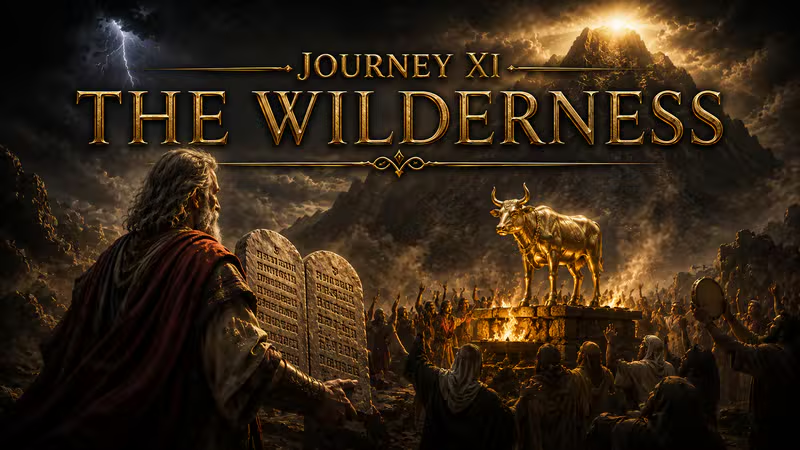
Journey XI
The Wilderness
Step outside the biblical canon. Explore how Jubilees, Josephus, and ancient traditions remembered Sinai, the Tabernacle, and the unseen realities of the wilderness journey.
Beyond the Biblical Account
The biblical story gives us the foundation.
But Israel's wilderness journey did not disappear from memory when the biblical books were completed.
For centuries, Jewish writers retold, interpreted and expanded upon these events.
Some preserved ancient traditions.
Some attempted to explain difficult passages.
Others looked behind the visible events and saw a greater conflict involving angels, idolatry, heavenly worship and unseen powers.
These writings are not all equal in age or authority, and they should not simply be treated as Scripture.
But when placed beside the biblical account, they allow us to hear how ancient readers understood the wilderness.
And sometimes—
they make familiar stories look surprisingly different.
1 — Jubilees
Moses on the Mountain
The Book of Jubilees retells much of Genesis and the early chapters of Exodus.
Its story begins in a striking place:
Mount Sinai.
Moses ascends the mountain, and God commands him to receive an account of history.
A heavenly figure—the Angel of the Presence—is then associated with communicating the record to Moses.
Jubilees 1 describes Moses being summoned upward and told that Israel will eventually rebel, turn toward foreign gods and break the covenant.
Yet the story does not end there.
It also anticipates repentance and restoration.
This gives Sinai an enormous perspective.
Moses is not merely receiving commandments for the present generation.
Sinai becomes a place from which Israel's entire covenant history is viewed:
Covenant → rebellion → judgment → repentance → restoration.
And Jubilees introduces another fascinating idea:
the earthly covenant is connected with a heavenly order.
2 — The Heavenly Tablets
Throughout Jubilees we repeatedly encounter an unusual expression:
the heavenly tablets.
Events and commandments are described as being written or established in heaven.
This reflects an ancient Jewish idea that God's purposes on earth correspond to realities already established in the heavenly realm.
That makes Sinai especially interesting.
The Law is not presented merely as Moses inventing a legal system for a wandering people.
It belongs to a much greater cosmic order.
And that leads directly to another wilderness mystery.
3 — The Tabernacle
A Copy of Something Greater?
In Exodus, Moses receives remarkably precise instructions for the Tabernacle.
And God tells him:
"See that you make them after the pattern for them, which is being shown you on the mountain."
— Exodus 25:40
That word pattern becomes extremely important later.
Hebrews looks back at the Tabernacle and says that the priests served:
"a copy and shadow of the heavenly things."
— Hebrews 8:5
This raises a fascinating possibility already contained within Scripture:
Was the Tabernacle an earthly representation of a heavenly reality?
Ancient Jewish thought often understood heaven and earth in precisely this interconnected way.
Temple.
Priesthood.
Altar.
Holy Place.
Most Holy Place.
Cherubim.
Presence.
Perhaps Sinai was not merely where Moses received instructions for constructing a tent.
Perhaps he was shown a pattern of something above.
4 — Josephus
The Wilderness Through an Ancient Historian
In the first century AD, the Jewish historian Flavius Josephus retold Israel's history in Antiquities of the Jews.
His account often follows the biblical narrative closely, but sometimes adds details or explanations.
Josephus describes the Israelites reaching Sinai and Moses ascending the mountain.
The people wait below.
Time passes.
And anxiety grows.
They fear that something may have happened to Moses.
Then Moses returns.
Josephus emphasizes the extraordinary nature of what has occurred and presents the Law as something received from God rather than invented by Moses.
But his description of the Tabernacle becomes particularly interesting.
5 — A Model of the Cosmos?
Josephus interprets parts of the Tabernacle symbolically.
He associates its divisions and sacred objects with the structure of creation.
The seven lamps of the lampstand, for example, are connected by Josephus with the seven planets known in the ancient world.
The twelve loaves are associated with the twelve months or zodiacal divisions.
Other parts symbolize the sea, land and heavens.
Whether every one of Josephus' interpretations reflects Moses' original intention cannot be demonstrated.
But his testimony is valuable for another reason:
an ancient Jewish writer saw the Tabernacle as a miniature representation of the ordered cosmos.
Suddenly the sanctuary in the wilderness becomes something enormous in meaning.
A small sacred structure—
representing creation itself—
with God's presence at its center.
6 — The Golden Calf
More Than a Statue?
The golden calf is one of the most disturbing moments of the wilderness story.
But to understand it, we must enter the religious world of the ancient Near East.
A divine image was not always thought to be the god itself.
Images could function as representations, earthly manifestations, or objects associated with the presence and authority of a deity.
This makes Aaron's declaration especially strange:
"These are your gods, O Israel, who brought you up out of the land of Egypt."
— Exodus 32:4
And then:
"Tomorrow shall be a feast to the LORD."
— Exodus 32:5
That creates an uncomfortable question.
Were the Israelites simply abandoning YHWH for another god?
Or were they attempting to represent and worship the true God in a forbidden way, using religious imagery familiar from Egypt and the surrounding nations?
Either way, the result is condemned.
God had revealed how He was to be worshipped.
Human beings replaced that revelation with an image they could control.
7 — Egypt Had Left Israel...
But Had Israel Left Egypt?
Israel had lived for generations surrounded by Egyptian religion.
Sacred bulls were well known in Egypt and the wider ancient Near East.
Power.
Fertility.
Kingship.
Divine strength.
All could be represented through bovine imagery.
The golden calf therefore did not appear in a cultural vacuum.
Israel had physically escaped Egypt.
But elements of the religious world around them may still have shaped their imagination.
This gives the wilderness story another dimension.
The Exodus removed Israel from Egypt.
The wilderness had to remove Egypt from Israel.
8 — Jasher
An Expanded Memory of the Journey
The work commonly printed today as the Book of Jasher should be handled carefully.
It is not demonstrably the lost ancient “Book of Jashar” mentioned in Joshua and Samuel.
The surviving work is a later Jewish retelling containing biblical material alongside expanded traditions.
That distinction matters.
Yet it is still interesting as evidence of how the story continued to be remembered and embellished.
Its wilderness sections retell Israel's fear, Moses' ascent of Sinai, the making of the calf and the conflict that followed.
The familiar biblical outline remains recognizable—
but the narrative is expanded into a more detailed dramatic history.
For The Triune Gates, Jasher is therefore useful not as independent proof of Exodus,
but as a window into later Jewish storytelling and interpretation.
That difference is important.
9 — The Psalms Remember
Some ancient reflections on the wilderness actually remain inside the biblical canon.
Psalm 78 retells Israel's journey almost like an ancient commentary.
It remembers the wonders in Egypt.
The sea.
The cloud.
The fire.
Water from the rock.
Manna.
And Israel's repeated rebellion.
One expression is particularly beautiful:
"Man ate of the bread of the angels."
— Psalm 78:25
Manna is described using heavenly language.
Bread in the wilderness—
associated with heaven.
Later Jewish readers would naturally wonder what this meant.
Was manna simply miraculous food?
Was "bread of angels" poetic language?
Or was the Psalm deliberately connecting Israel's physical provision with the heavenly realm?
The text leaves us something to think about.
10 — Angels at Sinai?
Exodus describes thunder, lightning, cloud, fire and trumpet sound at Sinai.
But later biblical texts introduce another element.
Deuteronomy 33:2 describes God coming from Sinai accompanied by myriads of holy ones.
Psalm 68 likewise portrays Sinai within the imagery of God's heavenly armies.
And Stephen says:
"You received the law as delivered by angels."
— Acts 7:53
Paul similarly refers to the Law as being mediated through angels.
— Galatians 3:19
This means that later biblical writers understood Sinai as involving more than Moses and God alone.
There is a heavenly assembly in the background.
Sinai may therefore be pictured as an intersection:
earth below
the mountain between
heaven above
And Moses enters the cloud.
11 — The Unseen Wilderness
Now something begins to emerge.
The wilderness contains an unusual concentration of places where heaven and earth appear to touch.
Sinai — God descends.
The cloud and fire — divine presence guides Israel.
The Tabernacle — God's glory enters an earthly sanctuary.
The Ark — cherubim surround the throne-like mercy seat.
Manna — bread comes from heaven.
The mountain — Moses receives a heavenly pattern.
The wilderness looks empty geographically.
Spiritually—
it is anything but empty.
12 — Azazel and the Wilderness
Then Leviticus introduces one of the strangest rituals in the Torah.
On the Day of Atonement, two goats are selected.
One is for the LORD.
The other is sent into the wilderness for Azazel.
— Leviticus 16:8–10
The identity of Azazel has been debated for centuries.
Some interpretations understand the word in relation to the goat's removal.
Others—including ancient Jewish traditions—understood Azazel as a personal supernatural being associated with the wilderness.
And here something remarkable happens.
Readers of 1 Enoch recognize the name immediately.
13 — Azazel in 1 Enoch
In 1 Enoch, Azazel is one of the rebellious supernatural figures associated with the corruption of humanity before the Flood.
He teaches forbidden knowledge.
Human violence increases.
Judgment follows.
Eventually Azazel is bound and cast into a desolate place.
That does not prove that Leviticus and 1 Enoch are describing exactly the same concept.
But the overlap is striking enough that scholars have long discussed it.
In one ancient Jewish tradition:
Azazel → rebellion → corruption → judgment → wilderness
And in Leviticus:
the sins of Israel are symbolically carried away—
into the wilderness.
The wilderness is therefore not merely empty land.
Within ancient religious imagination, it could represent the place outside the ordered sacred camp.
14 — Holy Space and Outside Space
Look at Israel's camp.
At the center:
the Tabernacle.
Around it:
Israel.
Beyond the camp:
the wilderness.
This creates almost a spiritual geography.
At the center is God's presence.
Moving outward brings increasing distance from the sanctuary.
On the Day of Atonement, impurity and sin are symbolically removed from the holy community and sent outside.
Away from the sanctuary.
Into the wilderness.
The geography itself begins to preach.
God brings holiness into the center.
Sin is carried away.
15 — A Strange Contrast
Now place two wilderness images beside each other.
At Sinai:
God descends from heaven.
In the camp:
God establishes His dwelling.
Outside the camp:
the goat carries sin into the wilderness.
One movement comes inward.
The other goes outward.
Presence comes in.
Sin goes out.
Whether every detail was intended symbolically cannot always be proven.
But the pattern is difficult to ignore.
16 — The Camp as Sacred Order
The arrangement of Israel itself becomes interesting.
God does not simply tell millions of people to camp wherever they please.
Numbers describes an ordered camp surrounding the Tabernacle.
The tribes occupy assigned positions.
The Levites serve closer to the sanctuary.
The Tabernacle stands in the middle.
Israel becomes a moving sacred community in the wilderness.
Wherever the cloud moves—
the entire ordered camp moves.
This is almost a portable kingdom.
No palace.
No permanent city.
No earthly throne.
Yet the King is present.
17 — What if the Wilderness was Never Empty?
This is where Gate II may cautiously ask its first real What if?
To modern eyes, wilderness means absence.
Nothing there.
Empty desert.
But ancient people often saw wilderness differently.
It could be dangerous space.
Uncontrolled space.
A place beyond civilization.
A place associated with hostile forces.
And yet—
that is precisely where God leads Israel.
What if this is part of the message?
God does not merely protect His people inside safe territory.
He leads them directly through the place they fear—
and places His own presence in the middle of it.
The wilderness does not become safe because nothing is there.
It becomes safe because—
God is there.
The Second Gate Opens
The ancient texts and traditions do not replace Exodus, Leviticus, Numbers or Deuteronomy.
They do something different.
They show us how generations of readers continued asking questions about them.
Was Sinai surrounded by a heavenly host?
Did Moses receive an earthly copy of a heavenly pattern?
Did the Tabernacle represent the cosmos?
Why was Azazel associated with the wilderness?
Why was God's dwelling placed precisely at the center of Israel?
And why do so many wilderness events later reappear in descriptions of Christ?
Some answers are explicit.
Some are ancient interpretations.
Some remain mysteries.
And some connections only become visible when the texts are placed beside one another.
That is exactly where Gate III begins.
Because now we can place on one table:
- Sinai.
- The heavenly host.
- The Tabernacle.
- The golden calf.
- Azazel.
- Manna.
- The Rock.
- The bronze serpent.
- Forty years.
- Forty days.
- And Jesus Christ.
And then ask the question The Triune Gates was built to ask:
What happens when all the pieces are placed together?
Gate III — Comparisons & Connections
The wilderness may have been far more than the road between Egypt and Canaan.
Enter Gate III