
Eden & The Fall
What is written?
God plants a garden eastward in Eden. It is a sanctuary of perfection, where humanity is placed not merely to live, but to dress it and keep it.
In the midst of this sanctuary stand two specific trees:
“...the tree of life also in the midst of the garden, and the tree of knowledge of good and evil.”
A single command is given: they may eat freely of every tree, except the tree of knowledge, for in the day they eat of it, they shall surely die. At this moment, the text tells us, Adam and Eve were both naked, and were not ashamed (Genesis 2:25).
The Serpent's Question
Suddenly, a sinister presence infiltrates the sanctuary. The biblical text introduces the serpent abruptly, without detailing a cosmic backstory here, but simply describing its supreme cunning within creation:
“Now the serpent was more subtil than any beast of the field which the LORD God had made.”
The serpent speaks to the woman. It does not force her; it plants doubt about God's word ("Yea, hath God said?") and God's intentions ("For God doth know that in the day ye eat thereof, then your eyes shall be opened, and ye shall be as gods...").
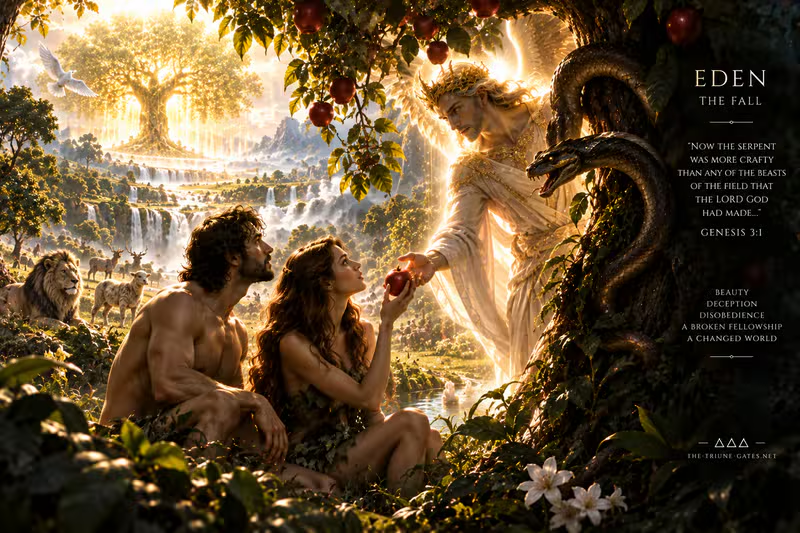
The transgression occurs. They eat.
The Eyes Opened
The immediate consequence is not physical death, but an instant change in perception:
“And the eyes of them both were opened, and they knew that they were naked; and they sewed fig leaves together, and made themselves aprons.”
The innocence is broken. When God walks in the garden in the cool of the day, humanity hides.
God addresses the three parties involved. The serpent is cursed above all cattle, commanded to go upon its belly and eat dust. Enmity is placed between the serpent's seed and the woman's seed. The woman is given multiplied sorrow in conception. The man is told the ground is cursed for his sake; by the sweat of his face he will eat bread, until he returns to dust.
The Coats of Skins & The Exile
Before the exile, God performs a profound act of provision and covering:
“Unto Adam also and to his wife did the LORD God make coats of skins, and clothed them.”
While often seen as the first shedding of blood to cover sin, deeper theological traditions ponder if these "coats of skins" represented more than just animal hides. Many suggest this was the moment humanity was clothed in dense, mortal flesh—a physical body to replace their original luminous, spiritual state.
Following this covering, the final judgment involves the second tree in the midst of the garden.
“And the LORD God said, Behold, the man is become as one of us, to know good and evil: and now, lest he put forth his hand, and take also of the tree of life, and eat, and live for ever...”
Adam and Eve are driven out. At the east of the garden, Cherubim are placed with a flaming sword to guard the way to the tree of life.
Scripture gives us the core narrative. But questions linger. How long were they in the garden? Why was Eve not surprised that a serpent could speak? What did the serpent look like before it was cursed to go on its belly? And what exactly did their "nakedness" mean?
To see how the ancient world answered these questions, we must step through the second gate.
Gate II
Ancient Texts
Genesis has closed. Now we step outside the biblical canon to discover the ancient traditions surrounding Eden.
Enter Gate II