
The First Rebellion
What is written?
In Genesis 3, a serpent appears in the Garden of Eden. It speaks, it deceives, and it initiates the fall of humanity.
But the text abruptly introduces this creature without giving us its backstory.
Where did this adversary come from? And what happened before Eden?
While Genesis focuses strictly on the earthly realm, other books of the Bible draw back the curtain to reveal a heavenly rebellion that shattered the peace of creation.
The Rule of Gate I
The Bible sets the foundation.
We tell the story from the canonical Scripture and let the important verses speak. The Bible gives us several glimpses of a heavenly rebellion, Satan, fallen angels, and judgment. But it does not provide one single chapter entitled: "The First Rebellion."
The familiar story is reconstructed by placing several passages beside one another. Therefore, this Gate asks only: What does the text actually say?
The Anointed Cherub
Ezekiel 28 contains an extraordinary passage. Through the prophet Ezekiel, God speaks a lament addressed to the king of Tyre.
Yet, the imagery reaches far beyond what we would normally expect in a description of an earthly king. The figure is described as a majestic divine being present in the garden of God:
“Thou hast been in Eden the garden of God; every precious stone was thy covering... Thou art the anointed cherub that covereth... Thou wast perfect in thy ways from the day that thou wast created, till iniquity was found in thee.”
He is described as perfect in his ways until iniquity is found in him. His heart becomes proud because of his beauty, and because of his corruption, he is cast down.
The Fallen Morning Star
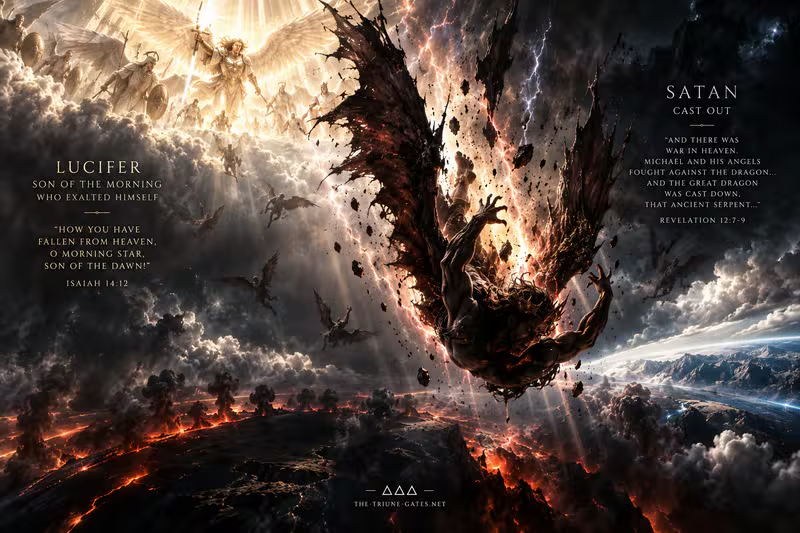
Isaiah 14 contains the famous words traditionally associated with the fall of Lucifer.
The figure desires to ascend into heaven, exalt his throne above the stars of God, and make himself like the Most High:
“How art thou fallen from heaven, O Lucifer, son of the morning! ... For thou hast said in thine heart, I will ascend into heaven, I will exalt my throne above the stars of God... I will ascend above the heights of the clouds; I will be like the most High.”
The immediate context of Isaiah 14 is a taunt directed against the earthly king of Babylon. Yet Isaiah describes the pride and downfall of this king using extraordinary cosmic and heavenly imagery.
Lightning and The Dragon
The consequence of this pride is recorded throughout the New Testament. Jesus Himself bears witness to a sudden, violent expulsion from the heavenly realm:
“I beheld Satan as lightning fall from heaven.”
And in the Book of Revelation, the Apostle John describes this conflict in sweeping, cosmic imagery:
“And there was war in heaven: Michael and his angels fought against the dragon... And the great dragon was cast out, that old serpent, called the Devil, and Satan, which deceiveth the whole world.”
Revelation 12:4 adds a terrifying detail: the dragon's tail "drew the third part of the stars of heaven, and did cast them to the earth." A faction of the heavenly host had joined the rebellion.
The Missing Timeline
Scripture gives us the pieces:
- A beautiful, anointed cherub.
- A fall driven by pride and a desire to be like the Most High.
- A war in heaven and an expulsion to the earth.
- A third of the stars (angels) swept away.
But the Bible does not explicitly link these events into a strict chronological timeline before Genesis 3.
When exactly did the cherub fall? Was it before Adam was created, or during Adam's time in the Garden? What was the exact catalyst for his pride? To see how the ancient world answered these questions and filled in the gaps regarding the unseen realm, we must step through the second gate.
Gate II
Ancient Texts & The Unseen
What did ancient Jewish and Christian traditions remember about the exact moment Satan fell?
Enter Gate II