What Was Remembered?
The Refusal to Bow
Scripture reveals the pride. Ancient texts reveal the catalyst.
The Rule of Gate II
Here we look at short actual passages and precise paraphrases with exact sources. We search for lesser-known stories, angels, adversaries, and heavenly events that the Bible leaves unexplored. We don't just talk *about* the texts; we let you read what they actually say.
Beyond the borders of Scripture, a vibrant collection of ancient traditions sought to explain the mysteries of Eden and the unseen realm.
While the Bible simply introduces the serpent as an adversary, early Jewish and Christian communities preserved extraordinary narratives detailing a direct conversation between the devil and Adam regarding *why* the rebellion took place.
The Life of Adam and Eve
One of the most fascinating ancient works is a collection of texts known as the Life of Adam and Eve (also preserved in Greek as the Apocalypse of Moses).
Dating back to the 1st century CE, these writings expand greatly on the lives of the first couple and peer directly into the angelic hierarchy. In this narrative, Adam explicitly asks Satan: "Why do you pursue us so fiercely? What have we done to you?"
The Command to Worship the Image
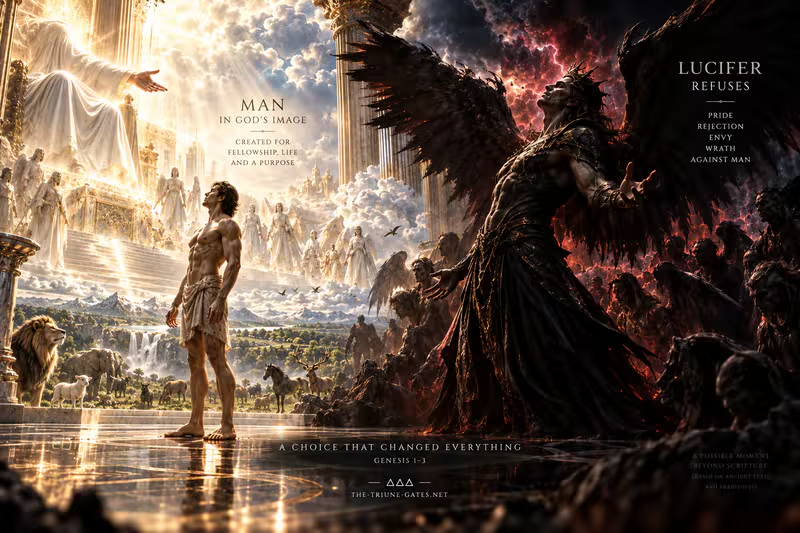
Satan's reply in the ancient text is startling. He reveals that his expulsion from the heavenly realms was directly caused by Adam's creation.
According to the text, when God breathed life into Adam, making him in the image of God, the archangel Michael brought Adam before the heavenly host and commanded the angels to pay homage to God's image.
"And Michael went out and called all the angels saying: ‘Worship the image of God as the Lord God has commanded.’ And Michael himself worshipped first; then he called me and said: ‘Worship the image of God the Lord.’"
But the devil refused. His reason was purely rooted in angelic hierarchy and pride over his own creation:
"I will not worship an inferior and younger being. I am his senior in the Creation, before he was made was I already made. It is his duty to worship me."
The Second Throne (2 Enoch)
The Life of Adam and Eve states that because of this refusal, God cast Satan and his angels down to the earth, filling Satan with eternal hatred for mankind.
Another text, 2 Enoch 29 (dating between the 1st century BCE and 1st century CE), describes the same primordial rebellion but focuses on the ambition to rise above God's own station. In this text, God tells Enoch about the fall of 'Satanail':
"One of these in the ranks of the Archangels, having turned away with the rank below him, entertained an impossible idea, that he should make his throne higher than the clouds over the earth, and should be equal in rank to my power."
These texts demonstrate how the ancient world understood the fall: an angelic being from the unseen realm, consumed by pride over his own antiquity and glory, either demanding God's throne or refusing to honor God's authority vested in humanity.
But how do these ancient memories align with the biblical prophets and the Book of Revelation? Are there more chilling connections waiting to be made? It is time to open the third gate.
Gate III
Comparisons & Connections
What appears when texts are placed beside each other, and we dare to ask "What if?"
Enter Gate III