Placing The Pieces Together
Scripture ↔ Ancient Texts ↔ The Unseen Realm
Gate I showed us the biblical warnings of pride and the war in heaven.
Gate II showed us the ancient tradition of the refusal to bow to Adam.
Now, we put everything on the table: Bible + extra-biblical texts + the unseen realm. We investigate parallels and dare to ask thrilling questions.
What If...?
What if the serpent in Eden was never just a talking reptile, but a fallen divine being—a seraph (burning one) or cherub stripped of his heavenly glory?
If Ezekiel 28 places this being in Eden as an "anointed guardian cherub" before iniquity was found in him, what if his presence at the Tree of Knowledge wasn't an outside invasion, but a former ruler returning to sabotage the new administrators (humanity) to whom God had just handed dominion over the earth?
What if his temptation wasn't just a lie, but a highly calculated political move within the unseen realm to reclaim a domain he felt was rightfully his?
The Bible doesn't explicitly state the serpent's original rank in Genesis, but placing the pieces of Ezekiel and ancient tradition together creates a chilling picture of cosmic jealousy and a war for dominion.
The Prideful Ascent
Isaiah 14 declares: "I will exalt my throne above the stars of God... I will ascend above the heights of the clouds; I will be like the most High."
2 Enoch 29 states the rebel Archangel "entertained an impossible idea, that he should make his throne higher than the clouds... and be equal in rank."
Analysis: The author of 2 Enoch directly incorporated the prophetic language of Isaiah 14 to describe the primordial fall of the angels, demonstrating that ancient Jews already read Isaiah 14 not just as a taunt against Babylon, but as the literal history of Satan's rebellion.
The Timeline of the Fall
Genesis does not specify *when* the serpent fell. It simply appears in Eden as an already-corrupted adversary. Ezekiel mentions the cherub was in Eden until iniquity was found.
The Life of Adam and Eve specifically claims the rebellion was triggered *because* of Adam's creation, placing the war in heaven on or just after Day Six.
Analysis: While the Bible leaves the timeline ambiguous, ancient readers felt the need to link Satan's hatred directly to Adam. By making Adam's creation the catalyst for the fall, this tradition provided a compelling motive for why the serpent immediately targeted humanity.
A Third of the Stars
Revelation 12 describes a dragon whose tail sweeps a third of the stars to the earth, followed by a war in heaven and his expulsion.
Popular tradition has solidified this as a historical event happening before Genesis 3: "Satan took exactly one-third of the angels when he rebelled."
Analysis: Revelation 12 contains a mixture of past, present, and future prophetic imagery (including the birth of Christ). While it confirms the dragon's fall and his followers, projecting the "one-third" statistic cleanly onto a pre-Eden timeline is an interpretation that tradition has cemented, rather than a strictly chronological biblical statement.
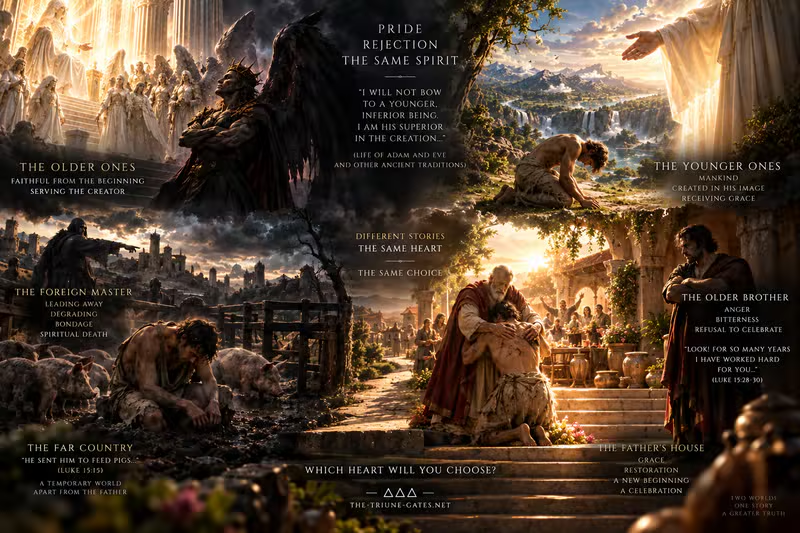
The Shadow of the Older Brother
In Luke 15, the Father throws a lavish feast for the younger, flawed son who returns. But the older son, who has been there from the beginning, refuses to join the celebration:
"The older brother became angry and refused to go in... 'Look! All these years I've been slaving for you...'"
In the Life of Adam and Eve, Satan refuses to honor God's grace given to humanity, demanding respect for his own seniority in creation:
"I will not worship an inferior and younger being. I am his senior in the Creation... It is his duty to worship me."
Analysis: While Jesus primarily directed this parable at the religious leaders of His day, the archetypal pattern perfectly mirrors the ancient Jewish understanding of the rebellion. The older brother represents the elder beings of creation (the heavenly host), who have served faithfully from the beginning. The younger son represents humanity—the latest beings created, flawed and prone to wandering. The older brother's bitter jealousy and refusal to celebrate the Father's love for the younger son echoes the ancient tradition of Satan's fall: a proud refusal to accept that the Creator would lavish such honor and grace on a younger, lesser being.
The Foreign Master: The parable deepens when the younger son leaves home. He attaches himself to a "citizen of that far country" who sends him to feed pigs—an act of ultimate degradation. If the younger son represents humanity exiled from the Father's presence, this foreign master perfectly shadows the fallen adversary. The rebel spirit lures humanity away from the Father's house, only to enslave, degrade, and starve them among the unclean things of the world, offering nothing but spiritual death until they finally "come to their senses" and return.
What We Cannot Know For Certain
The Life of Adam and Eve offers a fascinating, psychological motive for the rebellion. But it remains an extra-biblical story.
Scripture alone gives us the foundation: pride, a desire to usurp the throne of God, and a subsequent judgment.
We do not know the exact day the cherub fell. We only know that by the time Adam and Eve walked among the trees of the garden, the adversary was already there, waiting.
The rebellion in heaven had ended.
The rebellion on earth was about to begin.
The Fall of Lucifer
A Cinematic Interpretation
Scripture gives us several extraordinary glimpses of rebellion in the heavenly realm.
Isaiah speaks of one who desired to ascend above the stars of God.
Ezekiel describes an exalted figure whose beauty became corrupted by pride.
Jesus says:
"I beheld Satan as lightning fall from heaven."
— Luke 10:18
And Revelation describes the great dragon—identified as the Devil and Satan—cast down together with his angels.
When these passages are placed beside one another, a larger picture begins to emerge.
This cinematic presentation visualizes that traditional understanding of:
The First Rebellion.
A Note Before Watching
This film is a cinematic interpretation of the fall of Satan.
The Bible does not tell the complete story of Satan's original rebellion in one continuous passage. Instead, the traditional picture is constructed by comparing several biblical passages, including:
- Isaiah 14
- Ezekiel 28
- Luke 10:18
- Revelation 12
- 2 Peter 2:4
- Jude 6
Some of these passages have different immediate historical contexts, and Christians differ about how directly they should be applied to Satan. Therefore, watch this film as a visual interpretation of the connections explored in this Journey—not as a word-for-word reconstruction of one biblical account.
What Really Happened?
Was there a rebellion before Eden?
When did Satan fall?
Who were the angels who followed him?
Does Revelation's image of the dragon sweeping away a third of the stars of heaven describe the original rebellion—or something connected with events surrounding Revelation itself?
And are the rebellious heavenly beings mentioned in Jude and 2 Peter connected to the same event—
or to the later rebellion of the Watchers?
Scripture gives us pieces. Ancient writings preserve additional traditions. Gate III places those pieces beside one another.
But where Scripture remains silent, The Triune Gates should allow the mystery to remain.
Two Rebellions?
One important distinction may be emerging.
The rebellion associated with Satan may not necessarily be identical to the rebellion associated with the Watchers of Genesis 6. This opens another question:
Was there only one heavenly rebellion—
or were there several?
Next Journey
Eden & The Fall
The Garden.
The serpent.
And the fall of humanity.
The Triune Gates — Source Check
SCRIPTURE
- Ezekiel 28:13-17
- Isaiah 14:12-15
- Luke 10:18
- Luke 15:28-30 (Thematic)
- Revelation 12:4, 7-9
ANCIENT SOURCE
- Life of Adam and Eve (Latin Version) / Apocalypse of Moses (Greek Version)
- 2 Enoch 29