
What Was Remembered?
Eden in the Ancient Mind
Genesis provides the framework, but second-temple Jewish communities and early Christians preserved expansive traditions that filled in the narrative gaps.
Found among the Dead Sea Scrolls, the *Book of Jubilees* (written around 150-100 BC) retells Genesis with a strict focus on chronology and calendar cycles.
Genesis never states how long Adam and Eve lived in Eden. Jubilees gives an exact duration:
“And during the first week of the first jubilee, Adam and his wife were in the garden of Eden for seven years tilling and keeping it... And after the completion of the seven years, which he had completed there, exactly in the second month, on the seventeenth day [of the month], the serpent came...”
Furthermore, Jubilees offers an explanation for why Eve wasn't startled by a talking animal. According to this text, before the fall, *all* creatures shared a single language:
“And on that day was closed the mouth of all beasts, and of cattle, and of birds, and of whatever walks, and of whatever moves, so that they could no longer speak: for they had all spoken one with another with one lip and with one tongue.”
The *Apocalypse of Moses* (part of the broader *Life of Adam and Eve* literature, originating in the 1st century AD) provides Eve's own detailed, first-person account of the Fall.
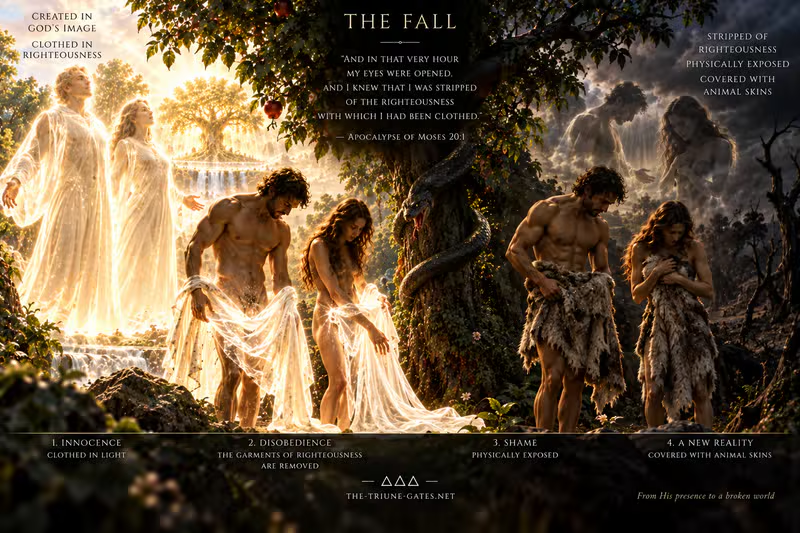
In this text, the "nakedness" they experienced was not merely the loss of clothing, but the loss of a divine, luminous glory that had covered them:
“And in that very hour my eyes were opened, and I knew that I was stripped of the righteousness with which I had been clothed.”
This tradition suggests Adam and Eve were clothed in "garments of light." When they sinned, the light faded, leaving them physically exposed.
This text also gives a striking physical description of the serpent's curse. In Genesis, it is told to crawl on its belly. The Apocalypse of Moses explains what it lost to make that happen:
“And the Lord said to the serpent: ‘...thou shalt be deprived of thy food which thou didst eat, and dust shalt thou eat all the days of thy life; upon thy breast and thy belly shalt thou go, and thou shalt be deprived of thy hands and feet. There shall not remain one of thy wings...’”
According to this ancient memory, the serpent was originally a winged, limbed creature—perhaps resembling a seraph (which literally translates to "fiery flying serpent" in other parts of Scripture).
But why did the adversary attack humanity in the first place? The *Life of Adam and Eve* (Vita 14:3) records a chilling scene where Satan explains to Adam that his rebellion was sparked by God's command to the heavenly host to honor His new creation:
“I will not worship an inferior and younger being. I am his senior in the Creation, before he was made was I already made. It is his duty to worship me.”
This text shifts the antagonist from a mere cunning animal to a proud, ancient celestial being consumed by envy, offering a stark backstage look into the unseen realm and the cosmic motive behind the temptation.
Gate III
Connections
When we place Genesis beside Jubilees and the Apocalypse of Moses, a vivid, expanded picture of Eden emerges. Which details are theological insight, and which are speculative tradition?
Place The Pieces Together