
Placing The Pieces Together
What appears when texts are compared?
Genesis gives us the essential theology of the Fall. The ancient texts attempt to answer the logical questions the Biblical text leaves open. By placing them side-by-side, we can analyze the strength of these ancient interpretations.
The Rule of the Gate
“Interesting” is not the same as “proven.”
We place all texts, history, and the unseen realm on the table to explore ancient paradigms and ask bold questions. However, the canonical Scriptures remain the ultimate foundation.
The "Nakedness"
Theological Insight"And the eyes of them both were opened, and they knew that they were naked..." (Genesis 3:7)
"...stripped of the righteousness with which I had been clothed." (Apoc. of Moses)
Analysis: The idea that Adam and Eve were clothed in "garments of light" or "glory" before the fall is one of the most widespread ancient interpretations (also found in the Aramaic Targums). It provides a profound theological explanation: they didn't just realize they lacked clothes; they realized they had lost the divine presence that previously covered them. God replacing their "fig leaves" with "coats of skins" represents the first covering of sin through sacrifice.
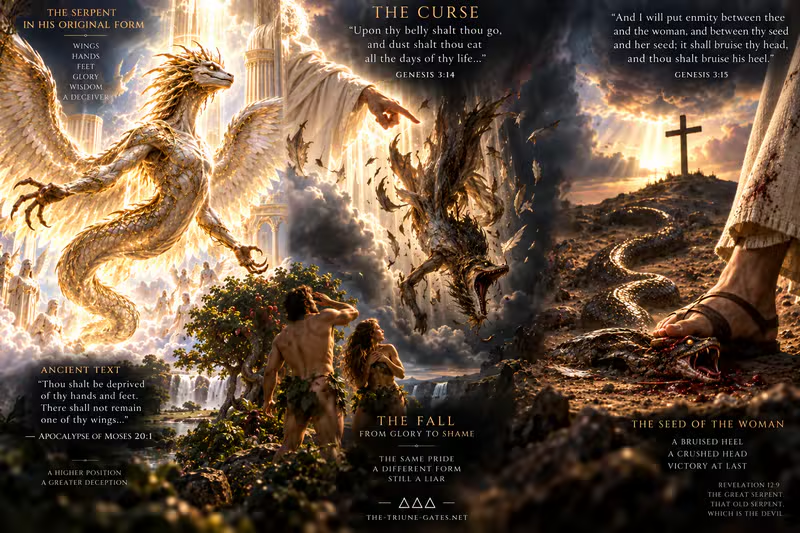
The Serpent's Original Form
Ancient Interpretation"Upon thy belly shalt thou go..." (Genesis 3:14)
"Thou shalt be deprived of thy hands and feet. There shall not remain one of thy wings..." (Apoc. of Moses)
Analysis: The biblical curse "upon thy belly shalt thou go" implies the creature previously moved differently. The ancient text attempts to describe what was lost. Interestingly, the Hebrew word for "serpent" (*nachash*) can be related to shining, and the fiery serpents in Isaiah (*seraphim*) have wings. The ancient text may preserve an understanding of the serpent as a formerly glorious, winged entity, matching its role as an angelic deceiver.
The Speaking Animals
Speculative Tradition"And he [the serpent] said unto the woman..." (Genesis 3:1)
"They had all spoken one with another with one lip and with one tongue." (Jubilees 3:28)
Analysis: Genesis does not explain why Eve was unfazed by a speaking animal. Jubilees solves this by claiming *all* animals could speak before the fall. While fascinating, this remains a highly speculative tradition born from a desire to resolve a textual gap, rather than something supported elsewhere in Scripture.
The Time in Eden
Chronological TraditionTimeline unspecified. Adam eventually lives to 930 years. (Genesis 5:5)
Exactly seven years before the Fall. (Jubilees 3:15)
Analysis: Jubilees is obsessed with the number 7 (weeks, years, jubilees). Assigning exactly seven years to Adam and Eve's time in Eden perfectly fits the author's mathematical framework. While we cannot verify this scripturally, it highlights the ancient Jewish desire to see divine, rhythmic order in all of redemptive history.
What If... The Shining One?
The Unseen RealmThe Hebrew word used for the serpent in Genesis 3 is nachash. While it is commonly translated as snake, the root word can also mean "to shine" or "to divine/whisper."
What if Eve wasn't talking to a literal reptile hanging from a branch, but to a luminous, seemingly divine being? A fallen member of God's heavenly council standing right there in the sanctuary of Eden?
If we connect this to Ezekiel 28—which describes an anointed cherub in Eden who was "perfect in beauty" before becoming corrupted by pride—the nachash becomes a brilliant, terrifying angelic adversary rather than a talking garden snake.