
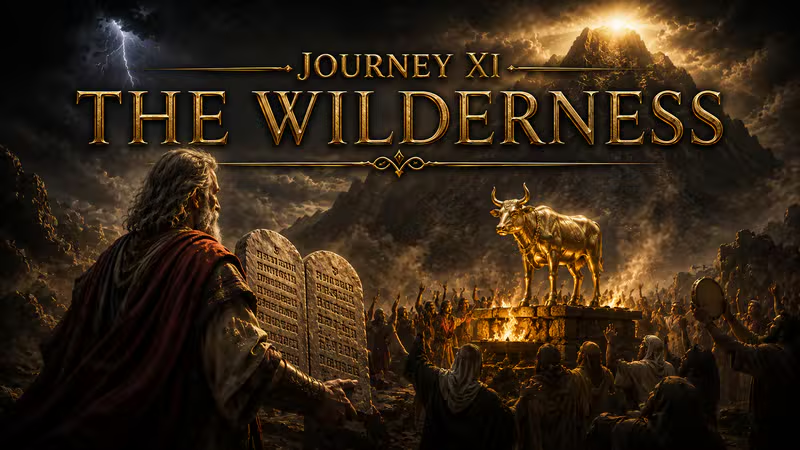
Journey XI
The Wilderness
Place Sinai, Babel, Eden, the Tabernacle, manna, the Rock, the bronze serpent, forty years, and Jesus Christ beside one another — and watch the pattern begin to emerge.
The Wilderness Between Two Worlds
Israel had escaped Egypt.
But something far greater was happening than the migration of a people through a desert.
Behind them stood Egypt:
Pharaoh.
Slavery.
Idols.
Temples.
The gods of Egypt.
Before them stood the Promised Land:
Canaan.
Giants.
Fortified cities.
Foreign gods.
And a promise given centuries earlier to Abraham.
Between those two worlds stood—
the wilderness.
And perhaps that position matters.
Because the wilderness appears to be the place where God takes a people shaped by Egypt—
and prepares them to become His people.
Connection 1 — The Exodus Was Over
But the Battle Was Not
Journey X showed us the Exodus.
God defeated Pharaoh and brought Israel through the sea.
But Scripture itself describes the plagues as more than disasters.
"On all the gods of Egypt I will execute judgments."
— Exodus 12:12
The physical oppressor had been defeated.
Yet Israel's behavior in the wilderness reveals something uncomfortable.
Egypt's influence had not simply disappeared.
The golden calf appears.
The people remember Egyptian food.
They complain.
They even speak of returning.
The chains had disappeared from their bodies—
but Egypt still lived in their memories.
The Connection
Perhaps the Exodus happened in two stages:
First: God took Israel out of Egypt.
Then: God began taking Egypt out of Israel.
And the second journey took much longer.
Connection 2 — The Golden Calf and the Unseen World
Now place the golden calf beside what we learned in Journey VII about the nations and the Divine Council.
After Babel, the biblical worldview describes nations associated with spiritual powers, while Israel belongs uniquely to YHWH.
Israel had just emerged from one of those nations:
Egypt.
A civilization saturated with divine images, sacred animals, temples and ritual.
Then at Sinai something extraordinary happens.
God claims Israel as His covenant people.
And almost immediately—
Israel creates an image.
This makes the golden calf more than a random act of stupidity.
It represents a collision between two systems:
The religious world Israel knew
The God who was teaching Israel how He was to be worshipped
Connection 3 — A God Who Refuses an Image
This contrast is enormous.
The ancient world was filled with images of gods.
Egypt had them.
Canaan had them.
Mesopotamia had them.
But Israel receives a command:
"You shall not make for yourself a carved image."
— Exodus 20:4
Why?
The biblical answer becomes fascinating when Genesis is remembered.
God already placed His image on earth.
Not stone.
Not gold.
Not wood.
Humanity.
"God created man in His own image."
— Genesis 1:27
What if...
The prohibition against idols carries a deeper message?
Humans keep trying to make images of God—
while God has already made His own image-bearers.
That turns idolatry upside down.
Connection 4 — Sinai as a Meeting Place
Mount Sinai deserves another look.
Throughout ancient cultures, mountains were frequently associated with the dwelling places or meeting places of gods.
Olympus.
Ziggurats imitating sacred mountains.
Temple mountains.
High places.
And then Scripture presents Sinai.
But Israel does not climb the mountain to discover God.
God descends.
Fire.
Cloud.
Thunder.
Trumpet.
Holy ones.
And Moses enters the cloud.
This is not humanity constructing a stairway upward like Babel.
It is God coming downward.
Babel
"Let us build... its top in the heavens."
Sinai
God comes down.
That reversal is worth noticing.
At Babel humanity attempts to reach heaven.
At Sinai heaven approaches humanity.
Connection 5 — Babel → Sinai → Pentecost
Now an even larger pattern appears.
At Babel:
humanity gathers in rebellion.
Languages divide.
Nations scatter.
At Sinai:
God forms one covenant nation.
Israel receives God's instruction.
Then, centuries later, at Pentecost:
people from many nations gather in Jerusalem.
The Spirit descends.
And people hear God's mighty works in their own languages.
But ancient Jewish tradition saw this connection long before Pentecost happened. When looking back at Sinai, the rabbis noticed that the Torah was meant for all humanity. An ancient tradition recorded in the Talmud states:
"Every single word that went forth from the Omnipotent was split up into seventy languages."
— Babylonian Talmud, Shabbat 88b
Seventy was the traditional number of the nations of the world since Babel. The ancient text suggests that at Sinai, God was already speaking to the scattered nations.
Babel — languages divided
Sinai — Israel formed
Pentecost — the message goes to the nations
The story that began with scattered nations begins moving outward again.
Not by building a tower upward—
but by the Spirit coming down.
Connection 6 — The Tabernacle and Eden
Now compare the Tabernacle with something much older.
Eden.
Genesis describes humanity living in God's presence.
After the Fall, humanity is expelled.
Cherubim guard the way.
Later the Tabernacle appears.
And what imagery do we find?
Cherubim.
Gold.
A lampstand shaped like a tree.
Sacred space.
God's presence.
The High Priest moves progressively inward toward the Most Holy Place.
At its center is the Ark.
Above it—
cherubim.
This has led many biblical scholars to see the Tabernacle and later Temple as containing Eden-like imagery.
The Pattern
Eden:
God dwelling with humanity.
Tabernacle:
God dwelling among Israel.
"The Word became flesh and dwelt among us."
— John 1:14
"The dwelling place of God is with man."
— Revelation 21:3
Suddenly the Tabernacle appears within a story stretching from Genesis to Revelation.
Connection 7 — The Tabernacle as a Miniature Creation?
Josephus saw cosmic symbolism in the Tabernacle.
Hebrews calls it a copy and shadow of heavenly things.
Genesis describes creation as ordered space in which humanity meets God.
The Tabernacle is ordered sacred space where Israel meets God.
So consider the progression:
Creation
Eden
Tabernacle
Temple
Christ
New Creation
The biblical story repeatedly returns to one theme:
God dwelling with His creation.
Perhaps the Tabernacle is therefore not a strange interruption in Exodus.
Perhaps it is a miniature picture of the entire story.
Connection 8 — Manna and Christ
Israel is hungry.
Bread descends from heaven.
Centuries later crowds surround Jesus.
They mention manna.
Jesus responds:
"I am the bread of life."
— John 6:35
The connection is explicit.
Manna kept Israel alive temporarily.
Jesus points toward eternal life.
Wilderness
Bread from heaven.
Gospel
Christ — the Bread of Life.
The physical provision becomes a theological signpost.
Connection 9 — Water from the Rock
Israel is thirsty.
The rock is struck.
Water flows.
Then Paul makes an extraordinary statement:
"For they drank from the spiritual Rock that followed them, and the Rock was Christ."
— 1 Corinthians 10:4
Notice the strange detail: "that followed them."
The Old Testament never explicitly says the rock moved. But ancient Jewish tradition did. The first-century text Pseudo-Philo records a widespread ancient belief about Israel's provision:
"He led His own people into the wilderness... and He brought forth for them the well of water that followed them."
— Pseudo-Philo, Biblical Antiquities 10:7
Paul, knowing this ancient tradition of the life-giving stream that journeyed with the people, uses it to make a breathtaking theological statement.
He invites us to read the wilderness typologically.
Bread.
Water.
Rock.
These are not merely disconnected miracles.
Later Scripture deliberately looks backward and sees Christological patterns within them.
This gives us permission to look carefully—
but not permission to invent anything we want.
The strongest connections are those Scripture itself makes.
Connection 10 — The Bronze Serpent
Perhaps no connection demonstrates this better.
Israel sins.
Serpents enter the camp.
People are dying.
God commands Moses to raise a bronze serpent.
Those who look toward God's provided remedy live.
Strange enough already.
Then Jesus says:
"As Moses lifted up the serpent in the wilderness, so must the Son of Man be lifted up."
— John 3:14
The wilderness event becomes a picture pointing toward the Cross.
Death surrounds the people.
God provides the means of life.
The afflicted person looks toward what God has raised up—
and lives.
Then comes John 3:16.
One of Christianity's best-known verses emerges immediately after Jesus recalls this strange wilderness story.
Connection 11 — Azazel and the Removal of Sin
Now we approach one of Gate III's more mysterious connections.
On the Day of Atonement, one goat is sacrificed.
Another bears Israel's sins and is sent away into the wilderness.
Leviticus associates this second goat with Azazel.
1 Enoch knows Azazel as a rebellious supernatural being connected with corruption and judgment.
We must be careful:
1 Enoch does not automatically explain Leviticus.
And scholars debate the meaning of Azazel in Leviticus.
But ancient Jewish tradition clearly developed the supernatural interpretation.
Now look at the imagery.
The Tabernacle stands in the center.
God's presence dwells there.
Israel's impurity is symbolically removed.
The goat carries it away—
out of the camp,
into the wilderness.
Sin
Removed
Carried Away
Outside
This is where later biblical theology becomes interesting.
Hebrews speaks of Jesus suffering outside the gate.
— Hebrews 13:12
Again, we should not force the texts into saying more than they say.
But the imagery resonates:
holiness within, impurity removed, sin carried away.
Connection 12 — Forty
Forty appears repeatedly around periods of testing and transition.
Flood — forty days of rain.
Moses — forty days on Sinai.
Israel — forty years in the wilderness.
Elijah — forty days to Horeb.
Jesus — forty days in the wilderness.
This does not mean every occurrence has a secret numerical code.
But Scripture repeatedly associates forty with testing, preparation, judgment and transition.
And the strongest parallel is Israel and Jesus.
Israel
Forty years.
Tested in the wilderness.
Jesus
Forty days.
Tested in the wilderness.
Both are tested in the wilderness.
Both experience hunger.
Both are connected with God's sonship.
But where Israel repeatedly fails—
Jesus remains faithful.
Connection 13 — "Out of Egypt I Called My Son"
God calls Israel:
"My firstborn son."
— Exodus 4:22
Hosea later says:
"Out of Egypt I called My son."
— Hosea 11:1
Originally, Hosea is speaking about Israel.
But Matthew applies the same words to Jesus.
— Matthew 2:15
Then something remarkable happens.
Israel
Egypt → water → wilderness → testing
Jesus
Egypt → baptism → wilderness → testing
The sequence resembles Israel's story.
Matthew appears to present Jesus as reliving Israel's journey—
but faithfully.
Connection 14 — Jesus Answers with the Wilderness
Satan tempts Jesus to turn stones into bread.
Jesus answers from Deuteronomy 8—
a passage about Israel's wilderness testing.
Jesus is tempted to test God.
Again His answer comes from Deuteronomy.
He is offered the kingdoms of the world in exchange for worship.
Again:
Deuteronomy.
Jesus' responses come from precisely the part of Scripture reflecting upon Israel's wilderness failures.
That is hardly accidental.
Where Israel failed its wilderness test—
Christ passes His.
Connection 15 — The Wilderness and the Unseen Enemy
Now we can cautiously open the door wider.
Israel enters the wilderness after God has judged Egypt and its gods.
Jesus enters the wilderness—
and encounters Satan.
Both stories therefore contain visible hardship alongside a spiritual dimension.
This does not mean every difficulty Israel experienced was caused by a demon.
Scripture does not say that.
But it does mean the Bible's wilderness is not spiritually neutral territory.
And ancient Jewish traditions intensify this imagery further through their associations between desolate places and hostile spiritual beings.
What if...
The wilderness represents more than geographical emptiness?
What if it functions repeatedly as a biblical borderland—
a place where human weakness is exposed,
where false powers lose their familiar structures,
and where allegiance to God is tested?
That would explain why wilderness experiences so often precede major missions.
Connection 16 — Moses and Jesus
Now place Moses and Jesus beside one another.
Moses ascends a mountain.
Jesus teaches from a mountain.
Moses gives God's Law to Israel.
Jesus reveals its deepest implications.
Moses fasts forty days.
Jesus fasts forty days.
Moses feeds Israel through God's provision.
Jesus feeds multitudes.
Moses mediates the covenant.
Jesus mediates a new covenant.
Moses intercedes for rebellious Israel.
Christ intercedes for His people.
The New Testament itself presents Jesus as greater than Moses.
"Moses was faithful... as a servant."
But Christ—
— Hebrews 3:5–6
"is faithful over God's house as a Son."
The wilderness therefore prepares categories that the Gospel later fills more completely.
Connection 17 — The Cloud, Fire and Spirit
Israel follows visible manifestations of God's presence.
Cloud by day.
Fire by night.
They do not determine the route.
God does.
When the cloud rises—
they move.
When it remains—
they wait.
Then the New Testament describes God's people differently.
Not a nation following a cloud across a desert—
but believers led by the Spirit of God.
The form changes.
The principle remains recognizable:
God's people are defined not merely by where they are going, but by whom they follow.
Connection 18 — A Mobile Kingdom
Here is perhaps one of the most beautiful images in Journey XI.
Imagine Israel from above.
An enormous camp in an empty wilderness.
Tribes arranged around the center.
And in the center:
the Tabernacle.
No permanent city.
No palace.
No human king.
Yet God's presence is among them.
When He moves—
the nation moves.
What if...
This was already a picture of something much larger?
A kingdom is not ultimately defined by walls.
It is defined by the presence of its King.
Israel could stand in a barren desert—
and still be closer to the Kingdom of God than Egypt with all its monuments.
Because Egypt had temples everywhere.
But Israel had—
the Presence.
Connection 19 — The Cloud and the New Creation
Ancient texts outside the main canon also saw something cosmic in the protective cloud.
The Book of Wisdom (or Wisdom of Solomon), written in the first century BC, looks back at the Exodus and describes the wilderness camp almost as a reversal of the chaos of the world:
"A cloud overshadowing the camp, and where water stood before, dry land appeared... For the whole creation in its nature was fashioned anew, complying with Your commands, that Your children might be kept unharmed."
— Wisdom of Solomon 19:7, 6
Here the ancient writer connects the wilderness protection directly to Creation.
Just as the Spirit hovered over the waters in Genesis to bring forth life, the divine cloud hovers over the camp in the wasteland.
Inside the cloud: order, life, and God's presence.
Outside: chaos, death, and the wilderness.
The camp becomes an outpost of Eden in a fallen world.
Connection 20 — The Wilderness Through the Whole Bible
The wilderness does not disappear after Moses.
David flees into wilderness.
Elijah enters wilderness.
John the Baptist appears in wilderness.
Jesus is tested in wilderness.
Revelation even describes a woman protected by God in wilderness.
Again and again the pattern returns.
Separation.
Testing.
Dependence.
Encounter.
Preparation.
The wilderness strips away what seems secure.
And asks:
What remains when everything else is removed?
For Israel, the answer should have been:
God.
Connection 21 — The Road from Eden to Revelation
Now step back.
Something enormous becomes visible.
The wilderness is therefore not an isolated chapter.
It stands directly in the middle of one of Scripture's greatest themes:
God returning to dwell with humanity.
The Triune Gates Connection
And perhaps this is the deepest lesson of Journey XI.
At first glance the wilderness seems to be about people wandering around for forty years.
Look closer.
It is about:
- freedom without trust.
- law without obedience.
- provision without gratitude.
- presence among rebellion.
And above all—
God remaining faithful to His promise.
Israel changes.
Generations die.
Moses grows old.
The landscape changes.
But God's purpose continues.
One Final "What If?"
Perhaps we have misunderstood what a wilderness is.
We tend to think:
If God is with me, the road should become easier.
But Israel's story says something different.
God's presence did not prevent the wilderness.
His presence led them through it.
The cloud was there.
The fire was there.
The manna was there.
The water was there.
The Tabernacle was there.
And yet—
so was the wilderness.
What if...
the absence of an easy road is not the same thing as the absence of God?
What if the wilderness is sometimes precisely the place where dependence becomes visible—
where idols are exposed—
where faith is tested—
and where we discover whether we wanted only God's gifts...
or God Himself?
Because the greatest miracle of the wilderness may not have been manna.
Nor water from the rock.
Nor even the fire upon Sinai.
Perhaps the greatest miracle was this:
After all their rebellion—
God still chose to dwell among them.
Journey XI — The Wilderness
Gate I showed us what Scripture records.
Gate II opened the ancient texts and the unseen world.
Gate III placed the pieces together.
And the road now leads toward the border of the Promised Land.
But waiting beyond that border are fortified cities—
strange peoples—
old enemies—
and the disturbing report of giants.
The wilderness is ending.
The next battle is about to begin.
Journey XII — The Promised Land
The promise was ancient.
The land was real.
And it was already occupied.