
Ancient Texts & The Unseen World
While the biblical prophets went silent after Malachi, the Jewish world was anything but quiet. Between the Old and New Testaments, the ancient world underwent massive shifts. Empires clashed, and deeply ingrained spiritual expectations evolved. Texts from this period provide a window into the minds of the people who were waiting for Jesus.
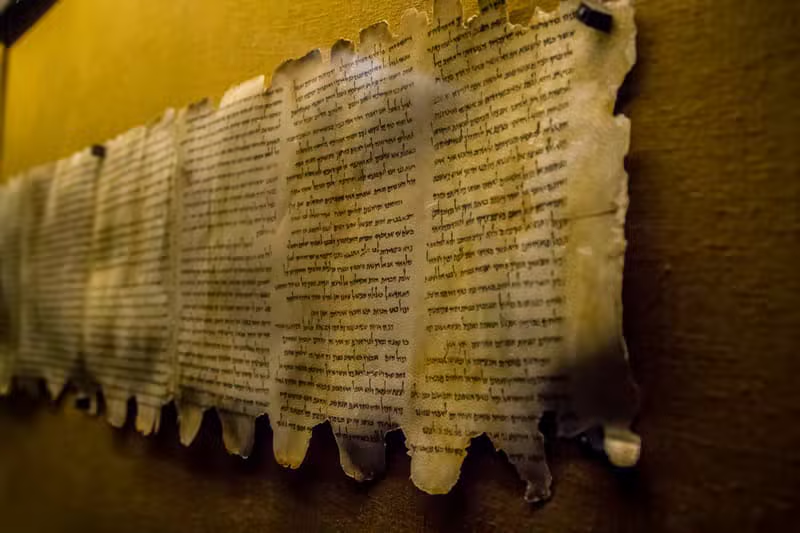
The Dead Sea Scrolls & The Messiah
Discovered in the caves of Qumran, the Dead Sea Scrolls reveal a community obsessively awaiting the end of days. Their collection demonstrates that Messianic expectations were incredibly diverse. They did not just present one uniform theology; some texts appear to expect two Messiahs—one royal (from David) and one priestly (from Aaron).
Furthermore, the famous War Scroll (1QM) outlines a dramatic, final conflict between the "Sons of Light" and the "Sons of Darkness." This was not just an earthly battle against foreign oppressors. It included an unseen dimension, where angelic forces clash and the hostile spirit Belial leads the forces of darkness. The unseen realm was deeply intertwined with their earthly struggles for purity and redemption.
1 Enoch & The Son of Man
The Book of Parables (part of 1 Enoch) expands on Daniel's vision of the "Son of Man." In Enoch, this figure becomes extraordinary: he is a heavenly being, closely associated with divine judgment, righteousness, and God's final victory. He is the one who will bring low the kings and the powerful figures of the earth.
The text speaks of this Son of Man (or "Chosen One") existing before the world was made. Scholars debate the precise nature of this pre-existence—whether it means he was literally present as a divine being, or if his "name" and destiny were foreordained in the mind of God before creation. What is clear is his exalted status:
"And before the sun and the signs were created, before the stars of the heaven were made, His name was named before the Lord of Spirits... And he sat on the throne of his glory, and the sum of judgment was given unto the Son of Man..."
— 1 Enoch 48:3, 69:27
Ben Sira (Sirach) & The Wisdom of the Ages
Written early in the second century BC, the Wisdom of Ben Sira (or Sirach) offers a profound look at Jewish faith during the Second Temple period. It praises the heroes of Israel's past—from Enoch and Noah to David and Nehemiah—weaving their stories into a tapestry of enduring hope. It shows a community deeply rooted in the Torah and wisdom, desperately holding onto God's promises while navigating the complexities of an encroaching Greek culture.
Maccabees & The Resurrection Hope
The books of 1 and 2 Maccabees document the horrific persecution of the Jews under the Greek king Antiochus IV Epiphanes, who defiled the Temple. The heroic revolt of the Maccabees restored the Temple (celebrated as Hanukkah), but it also solidified a fierce desire for political liberation and Jewish resistance.
Most remarkably, in 2 Maccabees 7, we see the clear, developed belief in the resurrection of the dead. As seven brothers face gruesome torture and martyrdom for refusing to break God's law, they express a defiant hope that the Creator of the universe will raise them back to life. This hope for bodily resurrection would become a central theological expectation leading into the time of Jesus.
Josephus & The March of Empires
The Jewish historian Josephus bridges the historical gap for us. He records the transition from Persian rule to the conquests of Alexander the Great, the terror of Antiochus, the brief era of Jewish independence under the Hasmonean dynasty, and finally, the crushing domination of Rome. It is into this powder keg of Roman occupation, political turmoil, and intense religious fervor that Jesus would eventually be born.
The world was not silent.
Expectations were growing: the Messiah, the Kingdom, the resurrection of the dead, divine judgment, the Son of Man, and the ultimate defeat of evil.