
Patterns & The Coming King
When we place the biblical narrative beside the ancient expectations of the unseen world, striking patterns emerge. The history of Israel is not merely a sequence of political events; it is a meticulously woven tapestry pointing toward a singular, cosmic arrival.
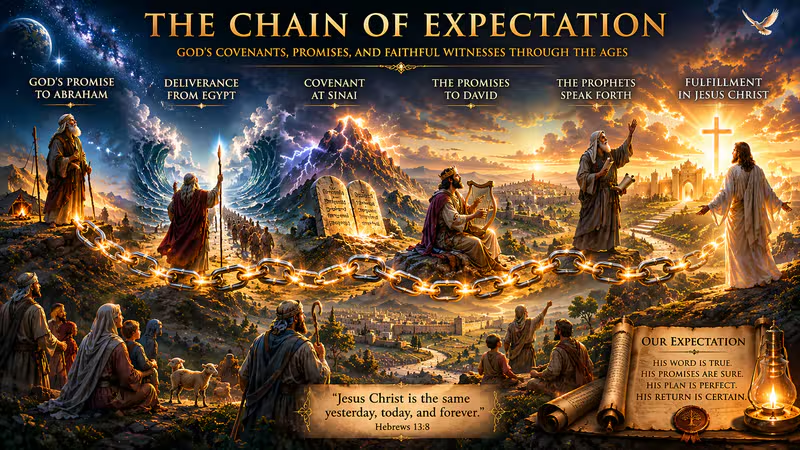
The Chain of Expectation
Look at the profound progression running through these centuries:
JUDGES → revealed the desperate need for a King.
DAVID → received the promise of an Everlasting Throne.
HUMAN KINGS → failed, demonstrating that salvation could not come from a mere mortal.
THE PROPHETS → pointed toward a future Messianic King and Suffering Servant.
THE EXILE → stripped away earthly security.
DANIEL → saw a heavenly Kingdom that would outlast all empires.
SECOND TEMPLE JEDAISM → nurtured a fierce expectation of resurrection and redemption.
BETHLEHEM → became the focal point where heaven touched earth.
Daniel → 1 Enoch → Jesus: The Son of Man
In Daniel 7, the prophet sees "one like a son of man" receiving everlasting dominion from the Ancient of Days. In the Book of Parables (1 Enoch), this concept was deeply expanded within Second Temple Judaism, picturing the Son of Man as an exalted heavenly judge and chosen one who would overthrow the wicked.
Then, in the New Testament, what is the title Jesus uses for Himself more than any other? "The Son of Man."
We do not need to claim that 1 Enoch is Scripture, nor that Jesus simply copied Enoch. Rather, these ancient writings provide the crucial Jewish context. When Jesus stood before the high priest and declared He was the Son of Man coming on the clouds of heaven, the Jewish leaders knew exactly what He meant. He was claiming the highest possible divine authority—a concept that had been brewing in Jewish thought for centuries.
Shadows and Types: Temple, Servant, and Light
The Temple: David desired to build God a house, but God promised to build David a dynasty. The physical Temple built by Solomon was a shadow. The true meeting place between heaven and earth would not ultimately be a building made of stone, but a descendant of David who embodies the presence of YHWH.
The Suffering Servant: While many expected a conquering military hero to smash the Romans, Isaiah had already laid out the path of a servant who would suffer, die, and bring redemption for transgressions. The victory would come through sacrifice.
Light and Darkness: The Qumran community (Dead Sea Scrolls) intensely focused on the cosmic battle between the Sons of Light and the Sons of Darkness. When we later read the Gospel of John—"The light shines in the darkness, and the darkness has not overcome it"—we realize this profound language resonated deeply within the Jewish world of the time.
WHAT IF... The Wait Also Had An Unseen Dimension?
Why 400 years of prophetic silence? Why did the Messiah not arrive immediately after the return from Babylon?
Scripture never explicitly states that these centuries were a delay caused by spiritual warfare. However, Daniel portrays earthly kingdoms operating alongside heavenly conflicts (such as the "Prince of Persia"). Later Jewish writings, like 1 Enoch and the Dead Sea Scrolls, heavily understood history against the backdrop of a cosmic struggle between good and evil.
What if ancient believers understood the political turmoil of these centuries as only the visible surface of a much larger conflict?
Persia. Greece. Antiochus. Rome. Kingdom after kingdom rises, oppresses, and falls. Yet Daniel saw another Kingdom—one that will never pass away. The world was being prepared.
The Judges showed the need for a King.
David received the promise of a King.
The Prophets said the King was coming.
Daniel saw a Kingdom that would never end.
Generations waited.
Empires rose and fell.
And then, the road leads to a small town called Bethlehem.