
Plank 1 — Realization
Before Noah picked up a single plank
The Ark didn't begin with wood.
The Ark began with realization.
God told Noah what was coming.
“The end of all flesh has come before Me... Behold, I will destroy them with the earth.”
— Genesis 6:13
Imagine that moment.
There was no flood yet.
No water crashing against houses.
No people fleeing to higher ground.
No Ark floating on the waves.
Only a warning about something that had not yet happened.
So Noah had a choice.
He could hear God's words and then continue with his normal life.
Or he could truly realize what he had been told.
He chose the latter.
Centuries later, Hebrews looks back on that moment:
“By faith Noah, being divinely warned of things not yet seen, moved with godly fear, prepared an ark...”
— Hebrews 11:7
Notice those words:
Things not yet seen.
Noah didn't wait until he saw the proof around him.
When the rain finally fell, he didn't need to be convinced anymore.
He had already made his decision when the sky was still calm.
What about us?
Jesus specifically used the days of Noah when He spoke about His coming.
“But as the days of Noah were, so also will the coming of the Son of Man be.”
— Matthew 24:37
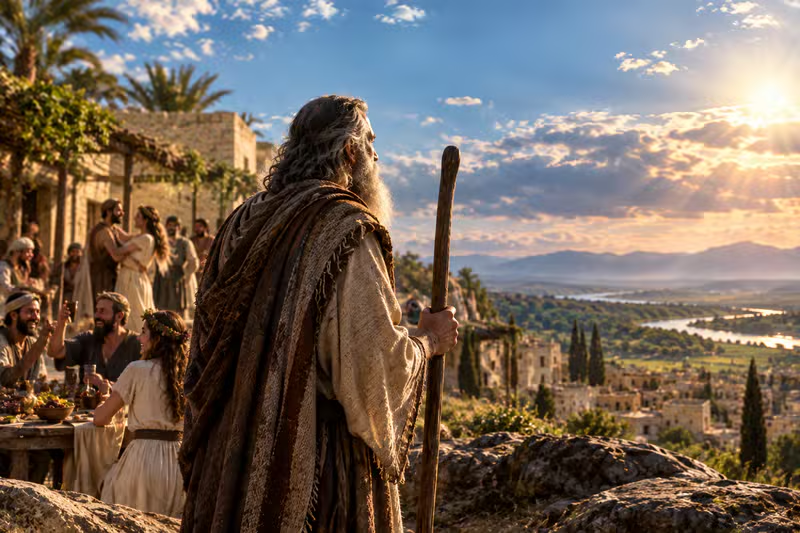
People were eating.
They were drinking.
They were marrying.
Normal life continued.
Until Noah entered the Ark and the flood came.
That doesn't mean eating, drinking, or marrying was wrong.
The problem was that daily life just continued while they did not realize what was approaching.
And right there, the story of Noah becomes uncomfortably close.
Because we too can read about prophecies.
We can talk about wars, unrest, deception, persecution, earthquakes, signs, and everything Jesus and the apostles described.
We can wonder what season we are living in.
We can even spend hours on Watchers, giants, ancient writings, and hidden mysteries.
But ultimately, one much more important question remains:
If you truly believe that Jesus' words are true — does that change anything about how you live today?
Look at the season
Jesus didn't teach His followers to calculate a date every day.
He taught them to be watchful.
“Watch therefore, for you do not know what hour your Lord is coming.”
— Matthew 24:42
So we don't have to say:
“It will happen tomorrow.”
We also don't have to claim that we know exactly where we are on God's timeline.
But we are allowed to look around us.
We are allowed to open the Scriptures alongside it.
We are allowed to see what is happening in the world.
And we are allowed to ask ourselves:
If this is the season in which I should be awake — am I awake?
Because perhaps the greatest danger isn't that you miss a sign.
Perhaps the greatest danger is that you look so much at signs that you forget why Jesus warned us in the first place.
Not so we would solve every mystery.
But so we would be prepared.
The cry in the night
That is why Jesus told another story.
Ten virgins were waiting for the bridegroom.
All ten had lamps.
All ten eventually fell asleep.
And then it happened unexpectedly:
“And at midnight a cry was heard: 'Behold, the bridegroom is coming; go out to meet him!'”
— Matthew 25:6
Suddenly, waiting had become reality.
The lamps had to burn.
And then it was revealed what everyone had truly brought with them.
Five had oil.
Five did not.
Up until that moment, their lamps might have looked the same.
But when the night came, the contents made the difference.
And therefore, already at this first plank, a question arises that will become much more important later on:
WHAT IS IN YOUR FLASK?
Not:
How many prophecies do you know?
Not:
How many mysteries have you solved?
Not:
How many stories about giants, Watchers, and the end times have you read?
But:
- Do you know Jesus?
- Do you know His Word?
- Do you trust Him when everything around you starts to shake?
- Have you learned to pray when you are afraid?
- Can your faith stand firm when you don't understand what is happening?
Those are questions that matter when night falls.
The first plank
Therefore, we are not going to run just yet.
We are not going to hoard supplies.
We are not going to look for a date.
And we are certainly not going to try to stop the storm ourselves.
We start where Noah started.
With realization.
God had spoken.
Noah believed Him.
And because he believed, he began to build.
The first plank of our Ark is therefore perhaps the simplest — and at the same time one of the hardest:
Take seriously what God has said.
Not out of panic.
Not out of fear.
But out of faith.
Look at your life.
Look at your lamp.
Look at your flask.
And ask yourself one question:
IF THE CRY WOULD SOUND TONIGHT...
would I wish I had started building yesterday?
If the answer is yes:
then today is a good day to lay down the first plank.
Plank 1: REALIZATION.
The sky may still be calm.
But Noah built before the rain.
Building The Ark