
Echoes in the Shadows
What the Ancient World Remembered
Genesis has closed. Now we step outside the biblical canon.
Beyond the borders of Scripture, ancient Jewish and early Christian texts preserve extraordinary expansions of the biblical stories. We do not treat them as equal to Genesis. But they act as windows into the ancient mind.
They show us that early readers didn't just see a six-day building project. They saw a cosmos teeming with angels, ancient conflicts, and profound mysteries.
The Creation of the Heavenly Host
In Gate I, we saw that Job 38 speaks of the "morning stars" and "sons of God" shouting for joy when the foundations of the earth were laid. But Genesis 1 never mentions when angels were created.
The Book of Jubilees (a 2nd-century BCE text found among the Dead Sea Scrolls) resolves this mystery by placing their creation on the very first day. It gives us a precise, vivid passage:
"For on the first day He created the heavens which are above and the earth and the waters and all the spirits which serve before him—the angels of the presence, and the angels of sanctification, and the angels of the spirit of fire, and the angels of the spirit of the winds..."
According to Jubilees, the heavenly hosts were established on Day One. They had to be there—so they could watch and sing as the rest of the universe was forged.
A War in the First Week
But not all angels rejoiced. The Book of the Secrets of Enoch (2 Enoch), a 1st-century CE text, claims something breathtaking: a cosmic rebellion happened during the creation sequence.
In this text, God personally explains the mechanics of creation to Enoch. On the second day, a high-ranking archangel named Satanail decides he will not serve:
"One from out the order of angels, having turned away with the order that was under him, conceived an impossible thought, to place his throne higher than the clouds above the earth, that he might become equal in rank to my power. And I threw him out from the height with his angels, and he was flying in the air continuously above the bottomless."
This is a staggering thought. In the ancient mind, the Earth was not just an empty stage waiting for humans; it was a territory located directly beneath the wreckage of a heavenly rebellion.
The Seventh and Eighth Thousand
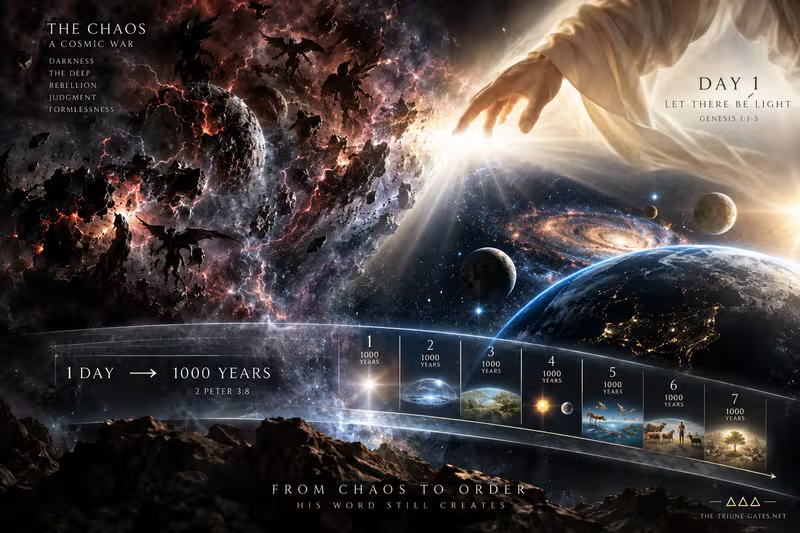
Finally, 2 Enoch does something Genesis itself never explicitly does. It takes the seven days of creation and turns them into a prophetic map of human history.
"And I appointed the eighth day also, that the eighth day should be the first-created after my work, and that the first seven revolve in the form of the seventh thousand, and that at the beginning of the eighth thousand there should be a time of not-counting, endless, with neither years nor months nor weeks nor days nor hours."
The text outlines a pattern:
- Days 1-6: 6,000 years of human history and struggle.
- Day 7 (Sabbath): A 7,000th year of profound rest.
- Day 8: The beginning of eternity, where time itself is destroyed.
This is what an ancient author believed. But what happens when we take these ancient memories—the angels, the rebellion, and the timeline—and place them back beside the Bible?
Gate III
Comparisons, Connections & What If?
Everything on the table. Scripture, ancient texts, history, and the unseen realm. What appears when we connect the dots?
Enter Gate III