
Putting Everything On The Table
Scripture + Ancient Texts + The Unseen
Rule of the Gate
“Interesting” is not the same as “proven.” We are placing everything on the table to examine the echoes and ask bold questions. But Scripture remains the only anchor.
The Witnesses to Creation
Job 38:7 states that when God laid the foundations of the earth, "the morning stars sang together, and all the sons of God shouted for joy."
Jubilees 2:2 specifically places the creation of all angelic hosts (angels of presence, sanctification, fire) on the very first day of the week.
Analysis: Genesis leaves the creation of angels unmentioned, creating a mystery when reading Job. Jubilees harmonizes the two: by declaring the angels were formed on Day One, they were present and able to witness and rejoice over the rest of the creation week.
The Shadow Over Creation
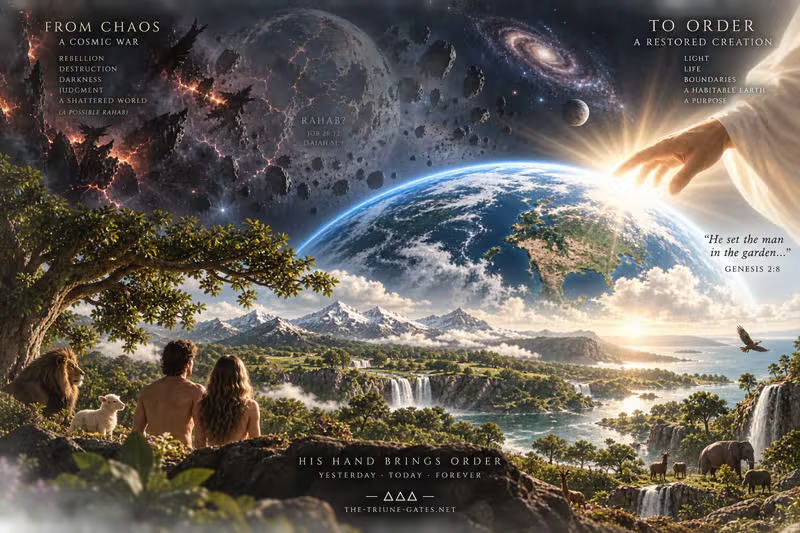
Genesis 1:2 tells us: "The earth was without form, and void; and darkness was upon the face of the deep."
We usually read this as a blank canvas waiting for paint. But 2 Enoch 29 says an archangel rebelled and was cast out into the air "above the bottomless" during the creation week itself.
What if... the darkness on the face of the deep wasn't just "unpainted canvas"?
What if it was the immediate aftermath of a cosmic war? What if humanity were not earth's first speaking creatures in an empty universe, but a newly established order in a contested domain? This would explain why a hostile entity (the serpent) was already present in the Garden shortly after Adam's arrival.
Adam and "The Day"
God said: "In the day that thou eatest thereof thou shalt surely die" (Gen 2:17). Adam lived 930 years (Gen 5:5). Peter says "One day is with the Lord as a thousand years" (2 Pet 3:8).
2 Enoch 33 equates creation days directly with 1,000-year periods of human history.
Analysis: Did early believers think Adam died "in the day" because he died before reaching 1,000 years? 2 Enoch proves that the "Day = 1,000 years" framework was an active theological lens in the ancient world, not a modern invention.
The Seventh Millennium
Revelation 20 details a 1,000-year reign of Christ (the Millennium) of perfect rest and rulership. 2 Enoch explicitly calls the 7th millennium a time of "rest."
What if... this timeline is actually ticking?
If the earth was roughly 4,000 years old (Day 4) when Christ was born, and nearly 2,000 years (Days 5 & 6) have passed since, we are nearing the end of the sixth "day." Because Jesus completed His earthly ministry at roughly 33 AD, some point to the year 2033 as potentially significant—the possible dawn of the 7th Millennium, before entering the eternal "8th Day" of endless time (New Heaven and New Earth).
What We Cannot Know For Certain
Genesis does not say: "The world will continue for six thousand years and Christ will return when those six thousand years have ended."
Neither Psalm 90 nor 2 Peter gives us permission to simply replace every biblical day with a literal timeline. Jesus Himself warns us against claiming knowledge of the precise day and hour.
Therefore, these connections should not become a rigid countdown.
But neither should we ignore the pattern.
Perhaps the creation week tells us only how creation began.
Or perhaps God placed within the beginning a pattern that would echo throughout history. Creation. Fall. Redemption. Restoration. Rest. And beyond the seventh—a new beginning.
The story begins with Creation.
And somehow—it ends with Creation restored.