
Journey VI
After the Flood
What Appears When We Place the Pieces Together?
Now Scripture and the ancient traditions can finally be placed beside one another.
Not to make them equal. But to ask questions.
Connection 1
The Flood Cleansed the Earth — But Did It Change the Human Heart?
Before the Flood:
“The wickedness of man was great.”
After the Flood:
Humanity still carries the inclination toward evil.
Then come: Noah's failure. Babel. War. Idolatry. Oppression.
The problem is deeper than the environment. Mankind itself needs restoration. And that begins pointing beyond Noah toward the need for Christ.
“The wickedness of man was great.”
After the Flood:
Humanity still carries the inclination toward evil.
Then come: Noah's failure. Babel. War. Idolatry. Oppression.
The problem is deeper than the environment. Mankind itself needs restoration. And that begins pointing beyond Noah toward the need for Christ.
Connection 2
Did Evil Survive the Flood?
Genesis shows evil continuing. Jubilees provides an ancient explanation involving surviving spirits.
The New Testament later speaks openly about demons and unclean spirits. Does Jubilees preserve an ancient attempt to explain their origin?
Possibly. But Scripture itself does not explicitly identify New Testament demons as the spirits of dead Nephilim.
Therefore:
Interesting ancient connection — not established biblical doctrine.
The New Testament later speaks openly about demons and unclean spirits. Does Jubilees preserve an ancient attempt to explain their origin?
Possibly. But Scripture itself does not explicitly identify New Testament demons as the spirits of dead Nephilim.
Therefore:
Interesting ancient connection — not established biblical doctrine.
Connection 3
Legion and the Appointed Time
When Jesus walked the earth, He encountered a man possessed by many demons who called themselves "Legion".
When they saw Jesus, they cried out:
"What have you to do with us, O Son of God? Have you come here to torment us before the time?"
— Matthew 8:29
Why "before the time"?
In 1 Enoch and Jubilees, the disembodied spirits of the dead Nephilim are condemned to roam the earth as evil spirits. They are allotted a specific lifespan to cause havoc until the day of final judgment.
The demons in the Gospel know exactly who Jesus is, and they know they have an appointed time of judgment. This perfectly aligns with the ancient Watcher tradition!
Furthermore, the name "Legion" denotes a massive military host. While a Roman legion consisted of thousands of soldiers, it is fascinating to note that in 1 Enoch, exactly 200 Watchers originally descended on Mount Hermon to rebel. The concept of an organized army of rebel spirits haunting the earth is a direct echo of ancient Nephilim lore.
When they saw Jesus, they cried out:
"What have you to do with us, O Son of God? Have you come here to torment us before the time?"
— Matthew 8:29
Why "before the time"?
In 1 Enoch and Jubilees, the disembodied spirits of the dead Nephilim are condemned to roam the earth as evil spirits. They are allotted a specific lifespan to cause havoc until the day of final judgment.
The demons in the Gospel know exactly who Jesus is, and they know they have an appointed time of judgment. This perfectly aligns with the ancient Watcher tradition!
Furthermore, the name "Legion" denotes a massive military host. While a Roman legion consisted of thousands of soldiers, it is fascinating to note that in 1 Enoch, exactly 200 Watchers originally descended on Mount Hermon to rebel. The concept of an organized army of rebel spirits haunting the earth is a direct echo of ancient Nephilim lore.
Connection 4
Did Forbidden Knowledge Survive?
1 Enoch associates the Watchers with forbidden teachings before the Flood.
Jubilees preserves a tradition in which Watcher-related knowledge is discovered afterward.
Then Babel follows.
Human civilization rapidly develops again.
This raises a fascinating question:
Was everything from the old world truly lost?
Ancient tradition says:
Perhaps not.
Scripture does not directly answer.
Jubilees preserves a tradition in which Watcher-related knowledge is discovered afterward.
Then Babel follows.
Human civilization rapidly develops again.
This raises a fascinating question:
Was everything from the old world truly lost?
Ancient tradition says:
Perhaps not.
Scripture does not directly answer.
Connection 5
Why Are There Giants After the Flood?
Before the Flood:
Nephilim.
After the Flood:
Rephaim. Anakim. Emim. Zamzummim. And later: Goliath.
Possible explanations have been proposed for centuries. But Scripture never clearly tells us which explanation is correct.
This should remain one of the open mysteries of The Triune Gates.
Nephilim.
After the Flood:
Rephaim. Anakim. Emim. Zamzummim. And later: Goliath.
Possible explanations have been proposed for centuries. But Scripture never clearly tells us which explanation is correct.
This should remain one of the open mysteries of The Triune Gates.
Connection 6
From Noah to Babel
God says:
Fill the earth.
At Babel humanity gathers and says:
Let us make a name for ourselves.
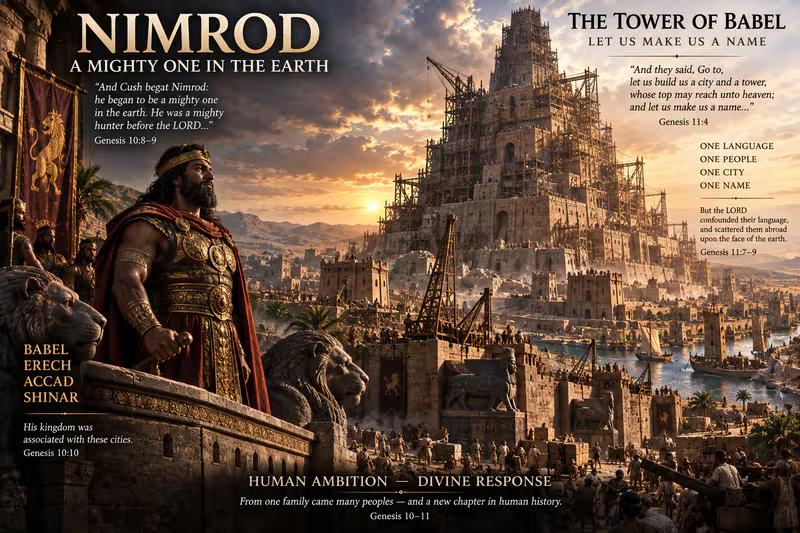
Creation and human ambition again collide. The people refuse dispersion. God scatters them. The nations are born into a divided world.
Fill the earth.
At Babel humanity gathers and says:
Let us make a name for ourselves.
Creation and human ambition again collide. The people refuse dispersion. God scatters them. The nations are born into a divided world.
Connection 7
Babel and the Nations
Genesis 10–11 describes the formation and scattering of nations.
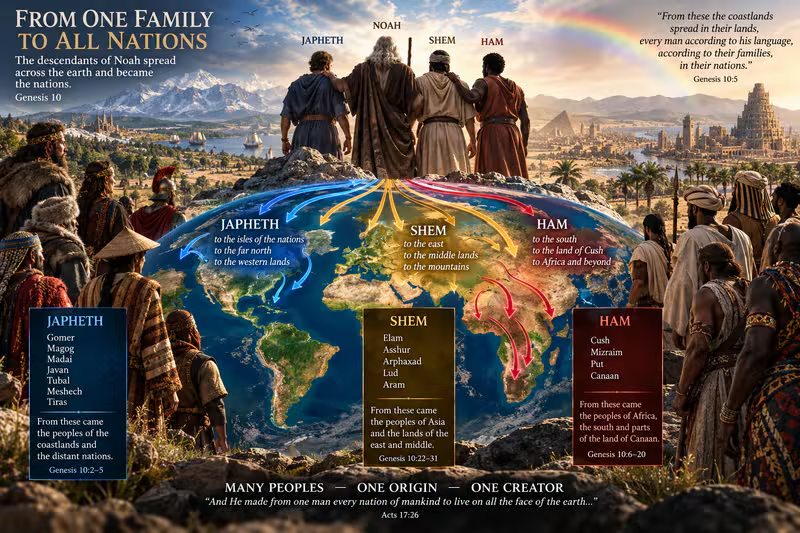
Deuteronomy 32 later speaks about the division of the nations in language that has generated enormous discussion, especially because the Dead Sea Scrolls and Septuagint preserve a reading involving the “sons of God.”
This may connect Babel with the biblical theme of the Divine Council.
That deserves its own Journey...
Deuteronomy 32 later speaks about the division of the nations in language that has generated enormous discussion, especially because the Dead Sea Scrolls and Septuagint preserve a reading involving the “sons of God.”
This may connect Babel with the biblical theme of the Divine Council.
That deserves its own Journey...
Connection 8
From Babel to Abraham
And then Scripture makes an extraordinary move.
Humanity tries to make:
a name for itself.
God scatters the nations.
Then God chooses one man:
Abram.
And God tells him:
“I will make thy name great.”
— Genesis 12:2
Humanity attempts to create its own greatness at Babel.
God gives Abram a great name.
Through him, God promises:
“In thee shall all families of the earth be blessed.”
The answer to Babel begins with Abraham.
Humanity tries to make:
a name for itself.
God scatters the nations.
Then God chooses one man:
Abram.
And God tells him:
“I will make thy name great.”
— Genesis 12:2
Humanity attempts to create its own greatness at Babel.
God gives Abram a great name.
Through him, God promises:
“In thee shall all families of the earth be blessed.”
The answer to Babel begins with Abraham.
The Greater Pattern
A Sequence Forms
Now the post-Flood story begins to form a sequence:
FLOOD — Judgment
↓
NOAH — Preservation
↓
COVENANT — Promise
↓
NATIONS — Humanity spreads
↓
BABEL — Human rebellion
↓
SCATTERING — The nations divide
↓
ABRAHAM — God begins His plan of blessing
↓
ISRAEL — A people is formed
↓
MESSIAH — Jesus comes
↓
THE NATIONS — The Gospel goes outward again.
What was scattered at Babel begins to receive an answer through Christ.
FLOOD — Judgment
↓
NOAH — Preservation
↓
COVENANT — Promise
↓
NATIONS — Humanity spreads
↓
BABEL — Human rebellion
↓
SCATTERING — The nations divide
↓
ABRAHAM — God begins His plan of blessing
↓
ISRAEL — A people is formed
↓
MESSIAH — Jesus comes
↓
THE NATIONS — The Gospel goes outward again.
What was scattered at Babel begins to receive an answer through Christ.
One Final Connection
Babel and Pentecost
At Babel:
Languages divide humanity.
Much later, at Pentecost:
People from many nations hear the mighty works of God—
in their own languages.
Babel scatters.
Pentecost gathers.
Babel says:
“Let us make a name.”
The Gospel proclaims:
the name of Jesus Christ.
And suddenly the story after the Flood is no longer merely ancient history.
It becomes part of a much larger story:
Creation → Rebellion → Flood → Nations → Abraham → Israel → Christ → Restoration.
The Flood was not the end.
It was another beginning.
Languages divide humanity.
Much later, at Pentecost:
People from many nations hear the mighty works of God—
in their own languages.
Babel scatters.
Pentecost gathers.
Babel says:
“Let us make a name.”
The Gospel proclaims:
the name of Jesus Christ.
And suddenly the story after the Flood is no longer merely ancient history.
It becomes part of a much larger story:
Creation → Rebellion → Flood → Nations → Abraham → Israel → Christ → Restoration.
The Flood was not the end.
It was another beginning.
The story continues...
Proceed to Journey VII