
The Mirror of Life
The World We Cannot See
You look out the window.
You see a street.
Houses. Trees. People.
Perhaps in the distance a church, an apartment building, or a forest.
Everything seems visible.
But suppose you are not looking at the entire reality.
Not because a second earth exists somewhere next to ours.
Not because every house is copied somewhere else.
But because our eyes can only perceive that part of reality for which our physical senses were made.

What if the visible world is not the whole reality?
The Bible gives us remarkable clues that there is more than what our eyes can perceive.
Visible and Invisible
Paul writes about Jesus:
"For by him all things were created, in heaven and on earth, visible and invisible..."
— Colossians 1:16
Visible and invisible.
And in 2 Corinthians, Paul again makes that distinction:
"As we look not to the things that are seen but to the things that are unseen..."
— 2 Corinthians 4:18
That is our starting point.
The Bible doesn't just talk about God somewhere far away in heaven.
It speaks of a reality of which a part is invisible to our eyes.
The interesting question therefore becomes:
How close to us is that invisible reality?
The Mountain That Did Not Change
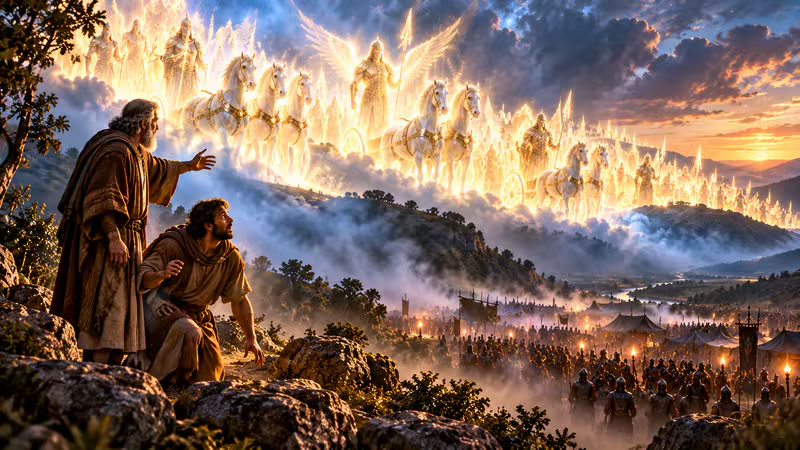
In 2 Kings 6, Elisha is surrounded by an enemy army.
His servant looks outside.
He sees horses, chariots, and soldiers.
Everything his eyes tell him leads to the same conclusion:
We are surrounded.
But Elisha says:
"Do not be afraid, for those who are with us are more than those who are with them."
— 2 Kings 6:16
The servant cannot see that.
Therefore Elisha prays:
"O LORD, please open his eyes that he may see."
— 2 Kings 6:17
And God opens his eyes.
Suddenly he sees that the mountain around Elisha is full of horses and chariots of fire.
Think about that for a moment.
The servant is not taken to heaven.
He does not travel to another earth.
The mountain does not disappear.
The visible world is not replaced by another world.
He suddenly sees more.
That might make this event the key to our entire search.
Reality did not change.
His perception changed.
The Protection Job Could Not See
In the book of Job, something similar happens.
Job himself does not know what is going on behind the scenes.
But Satan says to God:
"Have you not put a hedge around him and his house and all that he has, on every side?"
— Job 1:10
A hedge.
A kind of fence.
Around Job.
Around his house.
Around everything he owns.
Job does not see that protection himself.
But within the story, the adversary knows it exists.
Psalm 34 again uses strikingly spatial language:
"The angel of the LORD encamps around those who fear him, and delivers them."
— Psalm 34:7
Again:
around them.
Perhaps God's protection can be present without the one being protected seeing it with his eyes.
Elisha's servant was allowed to see it.
Job did not need to see it in order to be protected.
The Battle Behind the Visible
Daniel 10 takes us a step further.
Daniel prays, mourns and abstains for three weeks.
For Daniel, the days simply pass.
He prays.
He waits.
And outwardly, nothing happens.
But when a heavenly messenger finally appears, he tells him that Daniel's words were heard from the very first day.
He then speaks of opposition from the prince of the kingdom of Persia, and that Michael came to his aid.
What Daniel could perceive:
praying → waiting → silence.
What, according to the vision, was happening at the same time:
prayer heard → spiritual opposition → Michael → messenger reaches Daniel.
Daniel saw only one part of the event.
And with that, prayer takes on a remarkable dimension.
We do not need to be able to see what happens behind the scenes in order to believe that our prayer is heard.
Fasting, Prayer and Protection
Ezra faced a very practical danger.
He had to travel through dangerous territory with men, women, children and possessions.
So he proclaimed a fast to seek God and ask Him for a safe journey.
Afterward he writes:
"We fasted and sought our God for this, and He let Himself be entreated by us."
— Ezra 8:23
Here we must make something important clear.
Fasting is not magic.
Prayer does not, by itself, create a supernatural force field.
The protection comes from God.
But fasting, prayer, faith and humility are ways in which a person turns to God and places his trust in Him.
In Ephesians 6, Paul even uses the image of a suit of armor.
A breastplate.
A helmet.
A sword.
And:
the shield of faith.
Why?
Because Paul writes:
"For we do not wrestle against flesh and blood, but against the rulers, against the authorities..."
— Ephesians 6:12
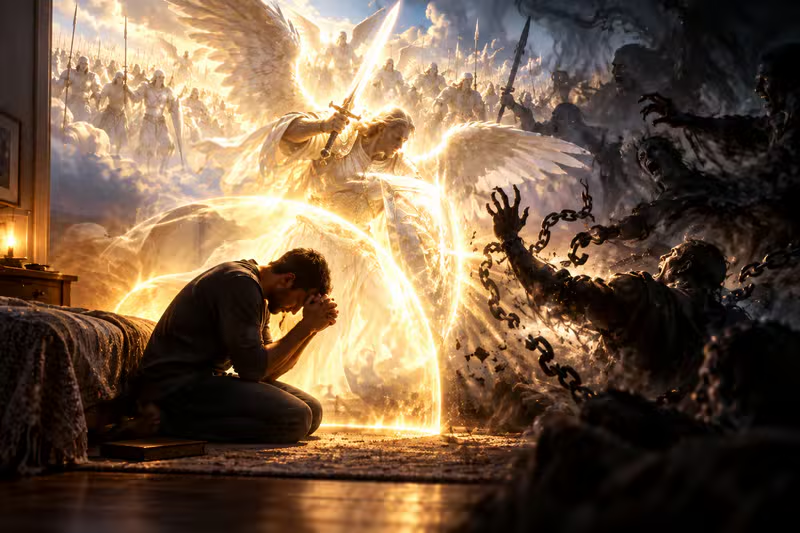
According to Paul, then, the battle is greater than what our eyes can perceive.
Perhaps we sometimes see only our side of the battlefield.
Peter Did Not See the Whole Picture Either
Just before Jesus is arrested, He says something remarkable to Peter:
"Simon, Simon, behold, Satan has demanded to have you, to sift you like wheat. But I have prayed for you that your faith may not fail."
— Luke 22:31–32
Peter did not see Satan.
He saw no spiritual battlefield.
He would experience only the visible events:
the arrest,
the fear,
the courtyard,
and finally his own denial.
But Jesus told him that behind that visible story, more was at play.
And once again we see the same pattern:
invisible opposition — and prayer.
And Then It Gets Even More Interesting: Buildings and Structures
So far we have spoken mainly about people, angels, spiritual opposition and protection.
But then we read Hebrews 8:5.
And there something different appears.
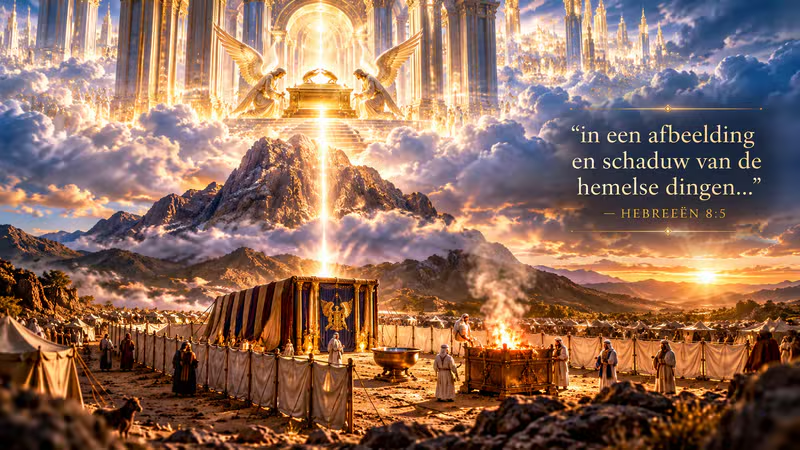
About the earthly sanctuary it is said that the priests serve:
"in a copy and shadow of the heavenly things..."
— Hebrews 8:5
Moses had to make everything according to the pattern shown to him on the mountain.
Read that again.
A copy and shadow of the heavenly things.
That does not mean that every house, every street or every building on earth has an invisible copy somewhere.
The Bible does not say that.
But Hebrews does show something extraordinary:
an earthly structure can correspond to a heavenly reality.
And Revelation goes further.
John writes:
"And the temple of God in heaven was opened, and the ark of His covenant was seen in His temple."
— Revelation 11:19
A temple.
An ark.
And Hebrews also speaks of:
"the city of the living God, the heavenly Jerusalem."
— Hebrews 12:22
A city.
So the spiritual reality is not described only as a formless space in which spiritual beings exist.
We also encounter structures.
And then our question grows larger.
Whatever Is Bound on Earth...
Jesus says to Peter:
"And whatever you bind on earth shall be bound in heaven, and whatever you loose on earth shall be loosed in heaven."
— Matthew 16:19
We find a comparable statement again in Matthew 18:18.
Within the context, Jesus is speaking about authority. We should therefore not make of this that any random human act automatically causes something in a hidden world.
But one thing is hard to miss:
Jesus connects what happens on earth with what happens in heaven.
Heaven and earth are not presented as though they have nothing at all to do with each other.
There is a connection.
A correspondence.
Places That Are More Than They Seem
Then we come to Jacob.
He is on a journey.
It grows dark.
He finds a place to sleep and uses a stone as a pillow.
To his eyes, there is little that is special there.
Ground.
Stones.
The night sky.
But during his sleep Jacob sees a connection between earth and heaven.
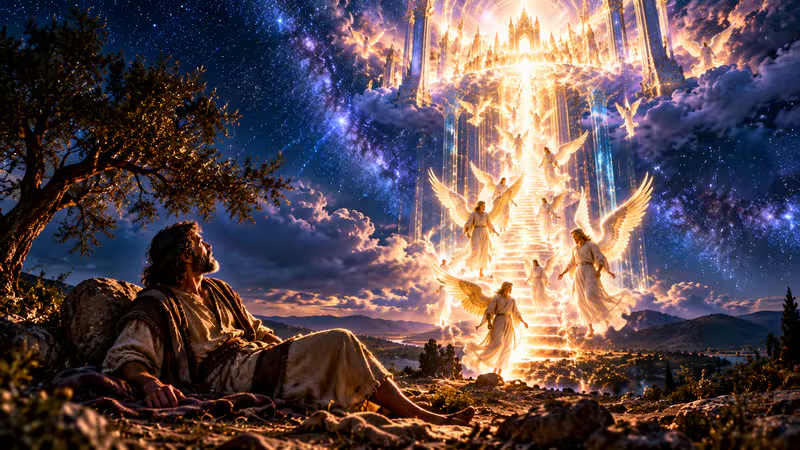
Angels ascend and descend.
When Jacob wakes up, he says:
"Surely the LORD is in this place, and I did not know it."
— Genesis 28:16
Pay particular attention to those last words:
"I did not know it."
Then he says:
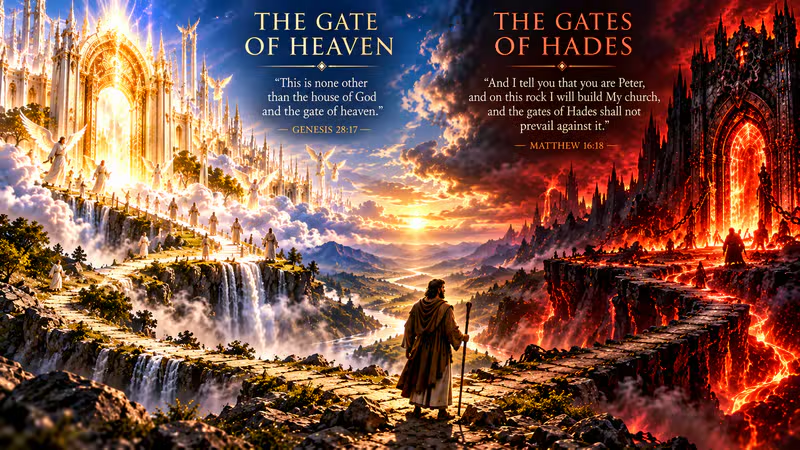
"This is none other than the house of God, and this is the gate of heaven."
— Genesis 28:17
The gate of heaven.
The place may have looked exactly the same before his dream.
But Jacob discovered that the meaning of that place was greater than what his eyes could tell him.
Holy Ground That Looked Like Ordinary Ground
Moses receives something comparable.
He sees a burning bush.
When he comes closer, God says:
"Do not come near; take your sandals off your feet, for the place on which you are standing is holy ground."
— Exodus 3:5
The ground looked like ground.
No visible boundary.
No wall.
No sign that said:
HOLY GROUND.
But God told Moses that this place was different.
Once again, the full meaning of a place is not necessarily visible to human eyes.
Gates
And then that remarkable word appears again:
gate.
Jacob speaks of the gate of heaven.
But centuries later, Jesus uses a very different expression:
the gates of Hades.
And the very place where He says it makes the passage interesting.
Hermon and the Watchers
Here we leave the biblical canon and look at an ancient Jewish text:
1 Enoch.
According to 1 Enoch 6, the Watchers decide to descend from their heavenly existence to the earth.
In doing so, a concrete geographical place is named:
Mount Hermon.
There, according to the text, they together swear their oath.
1 Enoch does not literally say:
"Hermon is a gate."
So we should not claim that either.
But within our line of inquiry, a fascinating possibility emerges.
If spiritual beings, according to this ancient tradition, came from their reality into our visible world precisely there...
what did that place mean?
The Gates of Hades
Centuries later, Jesus is with His disciples in the region of Caesarea Philippi, at the foot of the Hermon area.
It was a region with pagan sanctuaries, a large cave, and a spring.
There Peter confesses:
"You are the Christ, the Son of the living God."
— Matthew 16:16
And Jesus answers:
"...on this rock I will build my church, and the gates of hell shall not prevail against it."
— Matthew 16:18
Immediately afterward, Jesus speaks of:
binding on earth — bound in heaven.
Here too we must remain careful.
Matthew does not tell us that Jesus pointed to the cave and declared:
"There is literally a gate to Hades there."
And 1 Enoch does not literally call Hermon a gate.
But place the data side by side.
According to Enoch:
Hermon → Watchers descend from the heavenly reality.
In Matthew:
Hermon area → rock → gates of Hades → earth and heaven.
Is there a connection?
We cannot prove it.
But it is a remarkable question.
Enoch and the Gates of the Cosmos
And Enoch uses the image of gates far more often.
In the astronomical section of 1 Enoch, it is described how the sun and the moon travel their appointed courses through different gates.
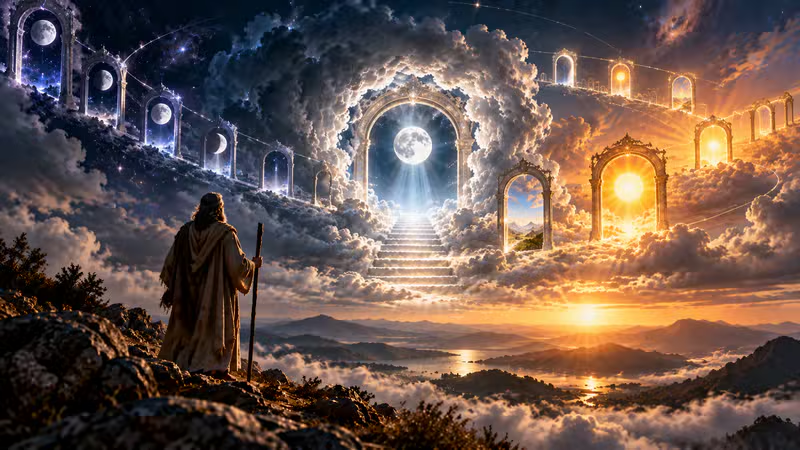
This is an ancient cosmological worldview.
We should not try to turn it into modern astronomy.
But for our search, something else is interesting.
The cosmos is there presented as:
ordered,
with boundaries,
places,
structures,
and gates.
Once again, the reality invisible to us is not a formless void.
There is order.
There are boundaries.
There are connections.
An Open Clearing in the Forest
And with that, we suddenly come very close to our own world.
Suppose:
you walk through a forest.
There is a clearing.
A few trees.
Moss.
Stones.
Perhaps nothing special at all.
Yet a person can sometimes experience a strong feeling at a certain place.
Rest.
Awe.
Or, conversely, unease.
Such a feeling is, in itself, no proof that a spiritual being, building, or gate is present there.
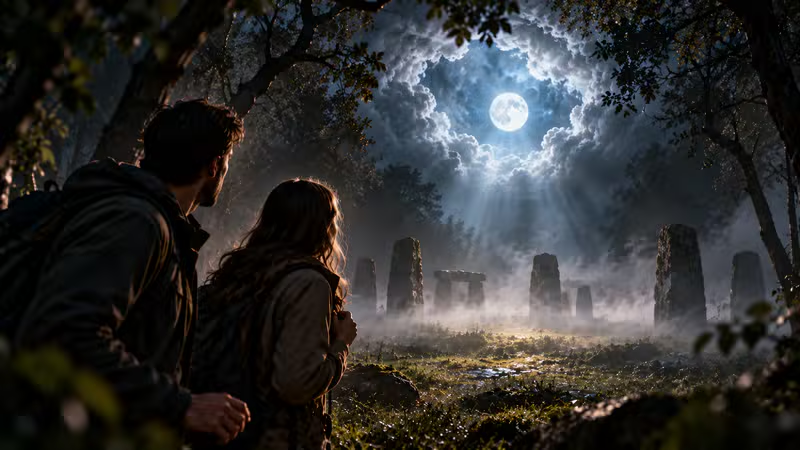
Our surroundings, memories, sounds, light, silence, and our own bodily reaction can cause such a feeling.
But if the visible reality really is not the complete picture, an interesting question arises.
Can we then look at that clearing with certainty and say:
"There is nothing there"?
Or could we really only say:
"There is nothing there that I can see"?
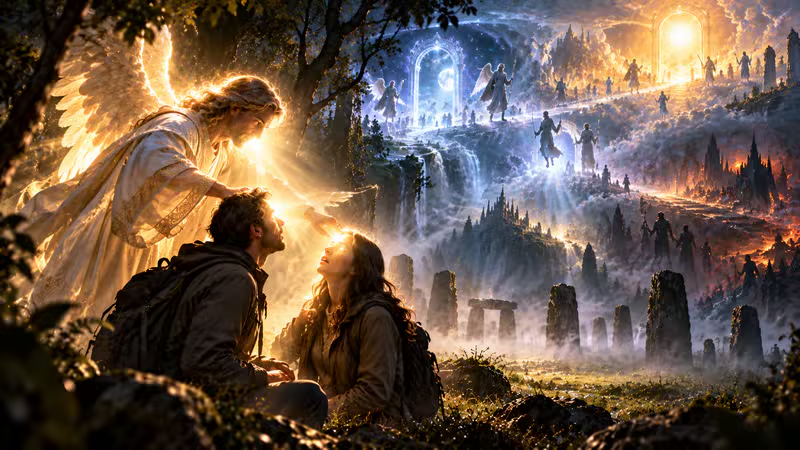
Suppose — and here we clearly enter the realm of WHAT IF? — that in such a place, within the complete picture, something exists that our physical eyes cannot perceive.
No visible door.
No stone temple.
No building we can touch.
But perhaps a presence.
A boundary.
A connection.
Or something for which we simply have no sense.
The Bible does not tell us that this is the case in such a random place.
And it gives us no command to go searching for hidden gates.
But Elisha's servant does teach us something:
that we do not see something does not automatically mean there is nothing.
What If?
Now we place everything side by side.
Elisha's servant looked at a mountain and did not see everything that was present there.
Job lived within a protection of which he himself could see nothing.
Daniel prayed while, according to his vision, a battle was taking place behind the scenes of which he initially knew nothing.
Peter lived through his visible story while Jesus told him about spiritual opposition that Peter himself could not see.
Ezra fasted and prayed for God's protection.
Paul spoke of a battle against invisible powers and of the armor of God.
Hebrews 8:5 calls the earthly sanctuary a copy and shadow of heavenly things.
Revelation describes a heavenly temple.
Hebrews speaks of a heavenly Jerusalem.
Jesus connects binding and loosing on earth with heaven.
Jacob calls a physical place the gate of heaven.
Moses discovers that ground which to human eyes looks like ordinary ground is holy ground.
Enoch describes an ordered cosmos with gates.
And the same Enoch tradition connects the descent of the Watchers with a concrete place on earth:
Hermon.
Perhaps We See Only a Part
So what if...
...the spiritual reality is not simply “very far away”?
What if the visible and invisible reality are connected in ways our physical senses normally cannot perceive?
What if events we view only from our human side have a much larger spiritual picture?
What if God's protection can be present around someone without that person seeing it?
What if prayer and fasting matter while we cannot perceive at all what happens behind the scenes?
What if a visible place can have a meaning that remains hidden from our eyes?
And what if “gates” sometimes need not be doors of wood, stone, or metal, but places of connection?
The Bible tells us there is more than we can see. And personally, I believe that too.
What we simply do not know is how much of that reality remains hidden from our eyes and how the visible and invisible are exactly connected.
Therefore our question remains:
WHAT IF?
Perhaps we make one mistake when we look at reality.
We say:
"I see nothing, so there is nothing."
While perhaps we could better say:
"I see nothing — but God sees the whole picture."
For when God opened the eyes of Elisha's servant, he did not have to travel to another world.
The mountain was already there.
The servant was already there.
And the horses and chariots of fire were there.
Reality did not change.
He simply saw more of what was already there.
Note: The sections about possible invisible structures, connections, and “gates” are research and speculation. The Bible passages mentioned are the basis; 1 Enoch is used as an ancient extra-biblical source. Where the texts end, the What if begins.
Created and compiled by
Richard Oskam
2 October 2026