Your time is precious — stay awake
Back to The Cases

Case 009

When Heaven Marked Time

Toen de Hemel de Tijd Aanwees

God's natural calendar, anchored by the fixed points of the heavens

What if the year is not determined by people, but by the fixed points that God placed in the heavens?

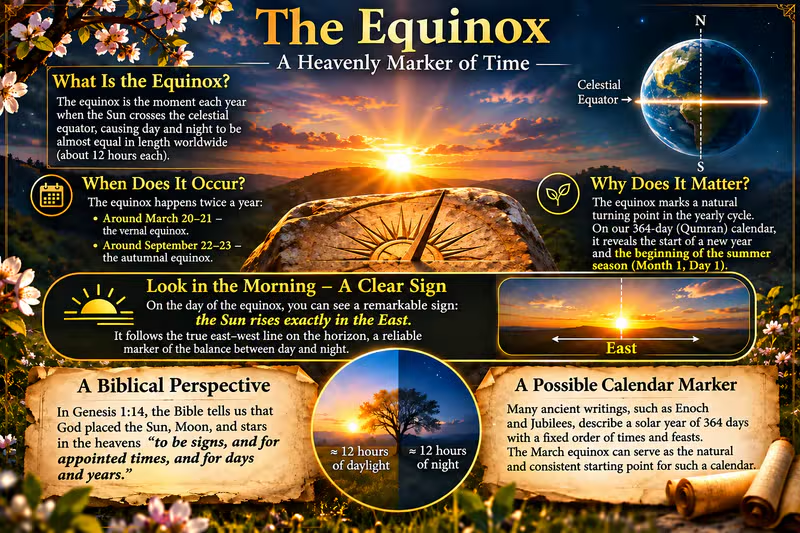
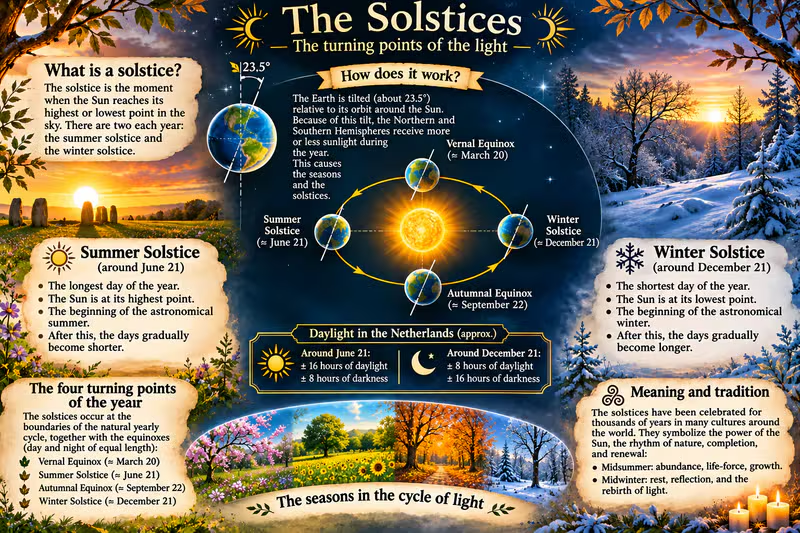
Every year the sun passes four fixed points. At the spring and autumn equinoxes day and night are equal. At the summer and winter solstices the sun reaches its highest and its lowest point in the sky.

These points return every year, with great regularity, independent of our calendar.

And precisely there my thought began: could these be the natural markers of times, dates, seasons and the appointed feasts that God gave His people?

Infographic explaining the fixed points of the year — the equinoxes and solstices — as heavenly markers of time and the seasons
Infographic about the solstices — the turning points of the light — the longest and shortest days of the year
The Triune Gates separator symbol
Part I

The Lights as Signs

In Genesis 1:14 we read that God said: «Let there be lights in the expanse of the heavens to separate the day from the night. And let them be for signs and for seasons, and for days and years.»

The heavenly lights are therefore not only meant to give light. According to Genesis, they also mark the appointed times.

God placed the sun, the moon and the stars to order time: the days, the seasons and the years.

The calendar begins not with people, but with the lights God set in the heavens.

And so the question arose: if the heavens mark the times, is there a fixed point in them where the year begins?

Genesis 1:14–18
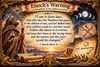
Enoch's warning about following the moon in its courses and keeping the feasts at the wrong times, so that the seasons and the years are changed
Part II

The Fixed Points of the Year

When we follow the path of the sun through the year, we find four fixed points.

At the spring equinox and the autumn equinox, day and night are equal in length. At the summer solstice the sun reaches its highest point, and at the winter solstice its lowest.

These four points return every year with great regularity, independent of any calendar that people have devised.

They divide the year into four seasons — spring, summer, autumn and winter — and they mark the times, the dates and the seasons.

After the flood, God made a promise:

«While the earth remains, seedtime and harvest, cold and heat, summer and winter, day and night, shall not cease.»

Genesis 8:22

These words describe a fixed order. The seasons return, the harvest comes, day and night follow one another — all according to God's arrangement.

The equinoxes and the solstices are the fixed reference points in this order: the points by which the year can be measured.

Genesis 8:22

Part III

The Appointed Feasts of the LORD

God did not leave the ordering of time to people alone. In Leviticus 23 He appoints His feasts — His appointed times.

«These are the appointed feasts of the LORD, which you shall proclaim as holy convocations; they are my appointed feasts.»

Leviticus 23:2

In the same chapter God gives His people the feasts that return every year:

The Sabbath: a weekly day of rest

Passover: the fourteenth day of the first month

Unleavened Bread: seven days from the fifteenth day

Firstfruits: the first sheaf of the harvest

Weeks: fifty days after Firstfruits

Trumpets: the first day of the seventh month

Atonement: the tenth day of the seventh month

Booths: the fifteenth day, the ingathering of the produce

They are days of joy, thanksgiving and remembrance — appointed times to come together before the LORD.

The feasts of the LORD are not ours to invent; they are given.

Leviticus 23

The Triune Gates separator symbol
Part IV

The Feasts in Their Seasons

The feasts of the LORD are not random dates. They follow the rhythm of the seasons and the harvests that God set in motion.

In the first month come the Passover and the Feast of Unleavened Bread, together with Firstfruits — the first sheaf of the barley harvest.

Fifty days later comes the Feast of Weeks, at the wheat harvest.

In the seventh month come the Feast of Trumpets, the Day of Atonement and the Feast of Booths, at the ingathering of the produce.

So every feast returns at its fixed place in the year, bound to the seasons that the heavens mark.

This is what ties the appointed times to the fixed points of the sun: as the seasons turn, the feasts return, year after year.

Leviticus 23:4–44

Part V

Our Calendar

Anchored to the fixed points of the year

That is why the calendar of The Triune Gates is aligned each year to the fixed points God placed in the heavens.

Read on to see why I begin with Summer.

On the UTC date of the March equinox the following begins:

Month 1 — Day 1

the symbolic beginning of summer

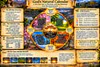
Overview of the calendar: the 364-day year with four quarters, the calendar year, the days outside the calendar and the symbolic seasons

After that follow 364 days, divided into four quarters of 91 days, each with its own seven-day week and sabbath.

When the 364 days are over, one or two days may remain before the next equinox.

These days fall outside our calendar count, but of course not outside real time.

«And that day is an eighth day, in which there is no day, no week, no month, no year, nor time.»

1 Enoch 91:16 · paraphrased

At the next equinox the new calendar year begins.

In this way the count remains connected year after year to the fixed points of the heavens and to the seasons God set in motion.

The calendar is a modern reconstruction, inspired by the ordering that the heavens themselves reveal and by the appointed times of Scripture.

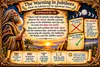
The warning in Jubilees about the calendar and the appointed times: the lunar year runs ten days too early, confusing the months, the Sabbaths, the feasts and the Jubilee years

Genesis 1:14 · Leviticus 23

Reflection

The Rhythm of God's Appointed Times

The year in God's order

God did not fill the whole year with feasts. He set the times of feasting and remembrance, and He alternated them with times of silence, of rest and of listening.

Three months with feasts and memorial days are followed by three months of rest. Then again three months with memorial and feast days, and then again three months of rest.

But people are inclined to break that silence, and they made feasts on days that God had not appointed.

Christmas, for example, falls in the three months that are meant for rest. Nor is it proven that Jesus was truly born on that date in December.

It is not very plausible that shepherds were out in the fields with their sheep during the cold December night.

There is, however, another feast of which it is said that the Word became flesh — look for yourself.

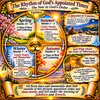
The rhythm of God's appointed times — the year in God's order, with the four seasons, the feasts and memorials and the times of rest

«And the Word became flesh and dwelt among us … full of grace and truth.»

John 1:14

Could this point to the Feast of Tabernacles — the feast on which God Himself came to dwell among His people?

Every feast day and memorial that falls outside this divinely appointed order is man-made — and falls under the warning of Jubilees and Enoch.

Genesis 1:14 · John 1:14 · Jubilees 6:36–38

The Triune Gates separator symbol
Part VI

The Spring of the Last Days

The four quarters of our calendar also received a personal, symbolic meaning:

Summer: creation and life the first 3 months

Autumn: decay and mortality the second 3 months

Winter: darkness and trial the third 3 months

Spring: expectation and preparation the fourth 3 months

And after that, summer begins again.

Why this particular order?

Because in Matthew 24 Jesus speaks about the events that precede His coming and the end of the age.

In the middle of that discourse He tells the parable of the fig tree:

«When its branch becomes tender and its leaves come out, you know that summer is near.»

Matthew 24:32 · loosely rendered

Jesus uses this image to teach His hearers to recognise the signs He has just described.

And I find that remarkable.

The fig tree buds in spring. But Jesus points to the summer that is near.

In my reflection that spring therefore stands as a symbol for the last days: a time in which the signs become visible, in which people are called to be watchful and to prepare.

And the summer?

It stands for the new beginning: the coming of Christ, the restoration and the life that God has promised.

It is not a calendar calculation of His return, but an image of hope and expectation.

The buds appear.
Summer is drawing near.

Matthew 24:32–33 · Luke 21:29–31

Closing

A Discovery to Ponder

Genesis speaks of lights that mark the seasons and the appointed times.

God gave the fixed points of the year — the equinoxes and the solstices — as signs in the heavens.

In Leviticus 23 God appointed His feasts, the days of joy, thanksgiving and remembrance.

And Jesus uses the budding fig tree to point to the summer that is near.

Could these fixed points and these feasts, each in their own way, show us something of God's ordering, the completion of time and the expectation of a new beginning?

Perhaps that is the most beautiful thought I received during this research:

What if we do not have to invent time ourselves, but may learn to recognise it anew in the heavens that God has created?

The buds appear.
Summer is drawing near.

Be prepared.

A personal discovery and reflection by Richard Oskam

The Triune Gates — Case 009

This calendar is a modern reconstruction, inspired by the ordering that the heavens reveal and by the appointed times of Scripture. The connections suggested are reflections, not an established prophetic timeline.

This unique calendar received its current form and function with the heavenly signs on 19 November 2026 — assembled by Richard Oskam through His mercy for the world, for His glory.