Your time is precious — stay awake
Back to The Cases

Case 008

While It Is Still Day

The light, the darkening, and the coming of the Bridegroom

A journey through Scripture, from the first light to the last night.

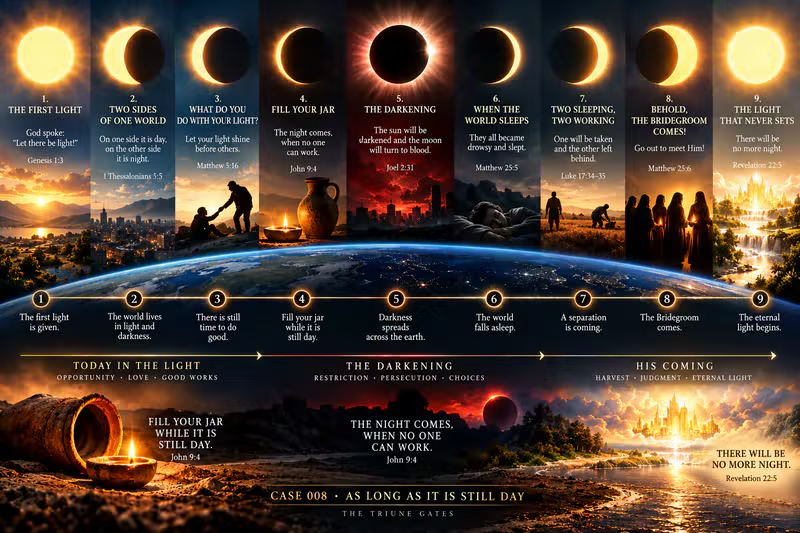
Case 008 timeline: from the first light to the last night

What if the sun, the moon, the light, and the darkness can teach us something about the time we have been given?

This story connects Bible passages with ancient writings and symbolic images. Not as a fixed explanation of the end times, but as an invitation to search for yourself.

Part I

Let There Be Light

In the beginning God spoke:

“Let there be light! And there was light.”

God separated the light from the darkness. He called the light day and the darkness night.

Later He set the sun, the moon, and the stars in the heavens, as signs, appointed times, days, and years.

The astronomical book of Enoch also describes the fixed courses of the heavenly lights.

The sun rose. The moon followed its path.

But while the heavenly lights kept their order, something on earth changed. Not in the sun or the moon, but in the heart of man.

Genesis 1:3–18 · John 1:4–5 · 1 Enoch 72–82
Part II

Two Sides of One World

On one side of the earth it was day.

People lived in freedom, worked, and went to church.

On the other side it was night.

There were people who lived in fear, were persecuted, or had barely enough food.

But on both sides were people who loved. And people who forgot their neighbour.

For the light of the sun does not tell what lives in someone’s heart.

“You are all children of light and children of the day.”

The true light does not depend on where the sun shines.

1 Thessalonians 5:5 · Matthew 5:14–16 · Qumran, Community Rule 1QS III–IV

Part III

What Do You Do With Your Light?

A rich man gave from his abundance.

A poor widow gave two small coins. Everything she had.

Jesus saw her.

It was not the size of her gift that made the difference, but what she gave from her heart.

And Jesus spoke of the hungry, the thirsty, the strangers, and the prisoners.

“Whatever you did for one of the least of these brothers of Mine, you did for Me.”

Perhaps you own little. But how much love can you give with what you do have?

Mark 12:41–44 · Matthew 25:35–40 · James 2:14–17

Part IV

Fill Your Jar

Fill your jar as long as it is still day

Ten virgins waited for the Bridegroom.

All ten had a lamp. But only five had brought enough oil.

While they waited, life went on.

There were the hungry, the poor, the prisoners, and people who needed help.

And Jesus had said:

“The night comes, when no one can work.”

For while it is still day, we have the opportunity to love, to give, to forgive, and to help our neighbour. But why would we wait to do so?

Is love still the same love when we show it only because our own life depends on it?

In the parable the oil is not literally explained as good works. But a sincere faith bears fruit, not only when it profits us.

Fill your jar while it is still day. And use your light for those for whom the night has already fallen.

Matthew 25:1–13 · John 9:4 · Isaiah 58:10 · James 2:17

Part V

The Darkening

Then the shadow began to spread. Slowly it grew darker.

Freedoms disappeared. Fear grew. The love of many grew cold.

The prophets had spoken of a darkened sun and a moon like blood.

John saw a time when people without a mark could not buy or sell.

And what if the night becomes so dark that no one can freely buy or sell? What if you no longer own anything to give away? What if helping becomes dangerous and your own life is at stake?

Then you may discover how precious the time was when you could still act freely.

Some will only then realise what they postponed for all those years. But others have already shown their love, long before they knew what the future would bring.

Not out of fear of being left behind.

Not to earn a place with the Bridegroom.

But simply because they loved Him.

And when the darkness falls, that love remains their testimony. Even then love can still become visible in faithfulness, forgiveness, and sharing the last that someone owns.

The darkening here is an image of increasing spiritual darkness and oppression.

What remains of our faith when it truly begins to cost us something?

Matthew 24:12–13, 21 · Joel 2:31 · Revelation 13:16–17 · 1 Enoch 80

The ten virgins asleep beneath an eclipsed moon as the world waits
Part VI

When the World Sleeps

The night fell. The ten virgins grew tired.

And then something remarkable happened:

All ten fell asleep.

Not only the foolish virgins. The wise ones too.

The difference was not who stayed awake the longest, but who had prepared.

Paul wrote:

“Let us not sleep, as others do, but let us be watchful and sober.”

Here Paul speaks of spiritual watchfulness, while the virgins literally fell asleep.

You can be awake and yet not ready. You can sleep and yet be prepared.

Matthew 25:5 · 1 Thessalonians 5:4–8 · Romans 13:11–12

Part VII

Two Sleeping, Two Working

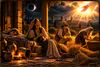
Two sleeping, two working: one rests while the other labours beneath an eclipsed moon as the light of the coming Bridegroom shines

On one side of the world it was night. Two people lay sleeping.

On the other side it was day. Two people were working in the field.

Jesus spoke of two people in one place, of whom one is taken and the other left. And He also spoke of the harvest as the end of the world.

What if we place these images side by side? One rested, the other worked. But their activity alone did not tell what lived in their hearts.

The meaning of ‘taken’ is explained in different ways. The connection with spiritual harvesters is also a symbolic thought here.

Not where you are, but to Whom you belong, is ultimately decisive.

Luke 17:34–35 · Matthew 24:40–41 · Matthew 13:39

Part VIII

Behold, the Bridegroom Comes!

In the middle of the night a cry rang out:

“Behold, the Bridegroom comes! Go out to meet Him!”

All ten virgins woke up. All ten took their lamps.

But five discovered that their oil was running short.

They wanted to be prepared after all. But the door was shut.

And then the piercing words were spoken:

“Truly, I say to you: I do not know you.”

It was not about who had recognised the most signs. Not about who knew the most about the end times.

But about truly belonging to the Bridegroom.

Do not wait until the last night to seek Him.

Matthew 25:6–13 · Matthew 7:21–23 · Revelation 14:12

Part IX

The Light That Never Sets Again

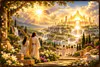
The eternal city bathed in golden light, where there is no more night

The darkening did not have the last word.

The prophet Malachi spoke of the Sun of righteousness that would rise.

John saw a new heaven and a new earth.

A place where no one would hunger or thirst any more. Where God would wipe every tear from the eyes. And where there would be no night any more.

“And there shall be no night there.”

For the Lord God Himself will enlighten them.

The first light sounded in Genesis. The eternal light waits at the end of Revelation.

Malachi 4:2 · Revelation 7:16–17 · 21:23–25 · 22:5

A Last Question

Perhaps we still live in freedom today. Perhaps we have food, a house, a Bible, and every opportunity to help others.

But somewhere else someone lives for whom the night has already fallen.

Someone who is hungry.

Someone who is persecuted.

Someone who prays for help.

Jesus did not ask us only to wait for His coming. He also taught us to love our neighbour. Not to earn our salvation by it, but because His love may change our lives.

Fill your jar while it is still day.

And use your light for those for whom the night has already fallen.

For no one knows when the Bridegroom comes. But today you can already follow Him.

What have you done today with the light that has been given to you?

The Triune Gates — Case 008

Bible texts form the foundation. Enoch, the Dead Sea Scrolls, and the symbolic heavenly images invite further study. The suggested connections are reflections, not a fixed prophetic timeline.