
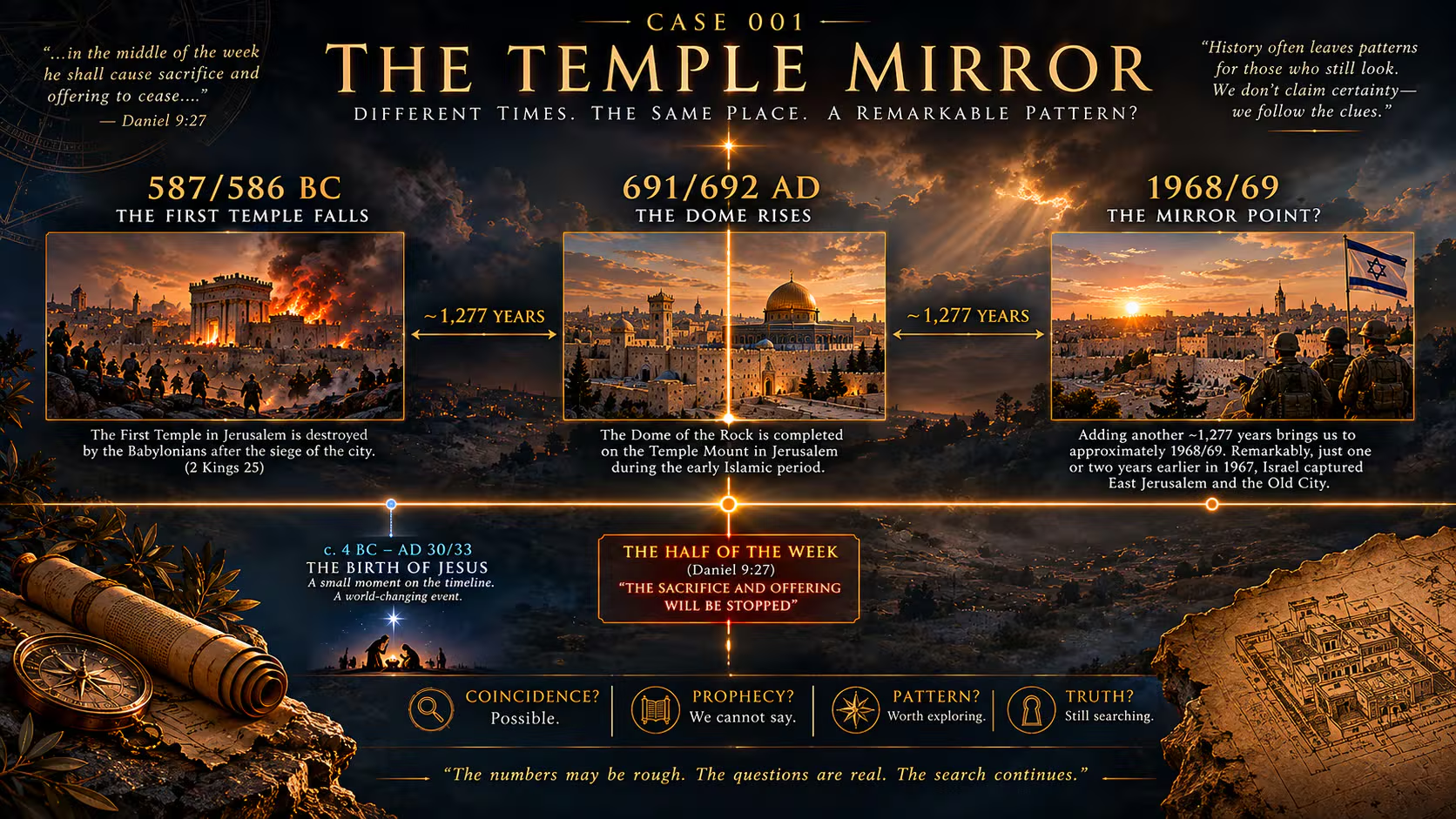
Our first case began with a simple question.
Daniel speaks about a decisive moment involving the sanctuary, sacrifice and an abomination.
And Daniel 9:27 contains one particularly intriguing expression:
“…in the middle of the week…”
Normally, this is investigated within Daniel's prophetic seventy weeks.
But Gate IV permits another question.
A much stranger one.
Today, on the ancient Temple Mount in Jerusalem, stands one of the most recognizable religious buildings on Earth:
The Dome of the Rock.
It was constructed centuries after the destruction of the Jewish Temple.
So we asked:
What if — purely as an experiment — we treated the appearance of the Dome as some kind of historical midpoint?
Not because Daniel says so.
He doesn't.
Not because we can prove the Dome is the abomination.
We cannot.
Simply because we wanted to see what would happen to the numbers.
So we started calculating.
The First Attempt
We began with the Second Temple.
Completed around the sixth century BC.
Destroyed by Rome in AD 70.
Then came the Dome of the Rock around AD 691–692.
We tried several ways of creating a mirror.
- > Construction → destruction.
- > Construction → Dome.
- > Destruction → Dome.
Then reflecting those intervals forward again.
The results?
Nothing particularly convincing.
Dates appeared.
But no obvious historical event jumped from the page.
Dead end?
Perhaps.
Normally, that might be where the investigation stops.
But this is Gate IV.
So instead we changed the question.
What if we used the First Temple?
Solomon's Temple takes us much farther back.
Again we tried its construction date.
Again we reflected the interval around the Dome.
Again…
nothing particularly remarkable appeared.
And then came another thought.
Wait.
Daniel isn't merely interested in when a sanctuary is constructed.
His prophecy repeatedly concerns its desecration, destruction and the stopping of sacrifice.
So perhaps we were looking at the wrong end of the Temple's history.
Instead of asking:
When was the First Temple built?
we asked:
When did it fall?
The Mirror
The First Temple was destroyed by the Babylonians around 587/586 BC.
Now move forward through history.
Approximately 1,277 years later we arrive around AD 691/692 — the period in which the Dome of the Rock was completed.
Now suppose — again, purely experimentally — that this is our mirror point.
Take approximately the same interval… and reflect it forward.
Another ~1,277 years.
Where do we arrive?
Approximately AD 1968–1969.
Nothing exact was expected.
Ancient dates have uncertainties. Calendars differ. There is no year zero. Construction can have a beginning date, completion date and dedication date.
So we weren't looking for precision to the day.
But then we looked at what happened around that period.
And something was sitting almost directly beside our result.
1967
WAIT…
In June 1967, during the Six-Day War, Israel captured East Jerusalem and the Old City.
For the first time in many centuries, the Temple Mount itself came under Israeli military control, although Islamic religious administration of the site continued.
Now look at our rough mirror again:
Does it fit?
Not exactly.
And that matters.
Our calculation did not produce 1967. It produced roughly 1968–69 depending upon the dates and counting method chosen.
We could force the numbers until they landed precisely on 1967.
But that would ruin the experiment.
The interesting part is precisely that we didn't start with 1967.
We started with the destruction of the First Temple.
We moved to the construction of the Dome.
We mirrored the approximate interval.
And only afterward noticed where we had landed.
Very close to one of the most consequential modern events involving Jerusalem and the Temple Mount.
But the case isn't finished
Now the questions begin.
- What happens if the First Temple was destroyed in 587 rather than 586 BC?
- What happens if a different date in the construction history of the Dome is used?
- What happens if dedication rather than completion matters?
- Could another ancient calendar shift the apparent interval?
- Is 1967 actually the important event?
- Or are 1968 or 1969 connected to something we haven't considered?
- Could the mirror point itself be wrong?
- Could the Dome be a marker rather than a fulfilment?
- Could another event on the Temple Mount provide a better center?
Or…
is the entire thing simply an extraordinary coincidence?
We don't know.
And in Gate IV — "We don't know" is an acceptable answer. - THE NUMBERS INSIDE THE MIRROR - There is one more curious detail. Daniel 12 gives two unusual periods connected with the removal of the daily sacrifice and the abomination: 1,290 days — Daniel 12:11 1,335 days — Daniel 12:12 Revelation also repeatedly uses 1,260 days for an end-time period. Now for a deliberately speculative Gate IV experiment: What if we temporarily read those days as years? From the destruction of the First Temple around 587/586 BC: 1,260 + 1,290 = 2,550 years That brings us to approximately 1964/65 AD — remarkably close to the 1967–1969 window already encountered in our Temple Mirror. And there is another curiosity: The Dome of the Rock was completed around 691/692 AD. Add Daniel's 1,335 — this time as years: 691/692 + 1,335 ≈ 2026/2027. Coincidence? Almost certainly possible. A biblical calculation? No. Daniel says days, not years. But Gate IV asks a different question: Why do these biblical numbers, when experimentally projected across Temple history, keep landing near dates that already appeared in the mirror? We have proved nothing. But the mirror just became a little more interesting. 🧐
The Mystery Check
From this case onward, whenever dates become interesting, we can perform another experiment. Around significant dates or calculated windows, we may also look for:
Not because an eclipse automatically means something prophetic. It doesn't. Not because every blood moon is a sign. It isn't.
But because Gate IV asks a different question: "Was anything else happening nearby?"
If nothing appears, we say so. If something almost fits, we record the near-match. And if several completely independent trails unexpectedly converge… we look again.
The Rule of the Forbidden Gate
"Never turn an interesting possibility into a fact merely because we want it to be true."
Everything else is open for investigation. Dates may move. Assumptions may change. Theories may fail. Cases may contradict one another. A theory we love today may be abandoned tomorrow.
And something that looks ridiculous today… may cause someone else to notice something extraordinary years from now.
Perhaps that someone will be you.
Case 001: The Temple Mirror
Your Turn
Perhaps we chose the wrong date. Perhaps we used the wrong calendar. Perhaps another Temple event belongs in the equation. Perhaps there is an astronomical event we haven't checked. Perhaps the entire mirror is meaningless.
Or perhaps you are looking at these numbers right now and thinking:
"Wait… you missed something."
If so — good. That is exactly why this gate exists.
The Case Remains Open
Case 001 — The Temple Mirror
To be continued…
Beyond The Map.