The Fall of the Watchers
1 Enoch & Jubilees
If Genesis 6 provides a summary, the ancient Book of Enoch (1 Enoch) provides the epic, terrifying details. This text was widely read in the Second Temple period and profoundly shaped how early Jews and Christians understood the flood.
1 Enoch calls these "sons of God" the Watchers. It even gives us their names, their leaders, and the location of their descent.
"And it came to pass when the children of men had multiplied... that the angels, the children of the heaven, saw and lusted after them... And Semjaza, who was their leader, said unto them: 'I fear ye will not indeed agree to do this deed...'"
They swore an oath together, two hundred of them, and descended on the summit of Mount Hermon.
The Forbidden Knowledge
According to 1 Enoch, the sin of the Watchers wasn't merely taking wives. It was what they taught humanity.
A watcher named Azazel taught men how to make swords, knives, shields, and breastplates. Others taught the use of roots, enchantments, astrology, and the beautifying of the eyelids (cosmetics) to seduce.
"And there arose much godlessness, and they committed fornication, and they were led astray, and became corrupt in all their ways."
This answers a massive question from Genesis: Why did the earth become "filled with violence" so quickly? Enoch argues it was because humanity was handed the heavenly technology of warfare and destruction before they possessed the wisdom to handle it.
The Giants
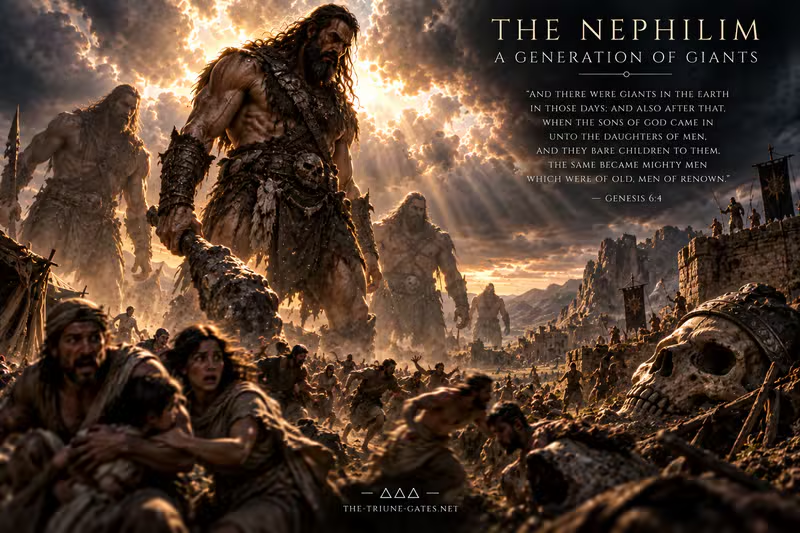
The offspring of this unnatural union were the giants (the Nephilim). But unlike the brief mention in Genesis, Enoch describes them as a horrific plague upon the earth.
"Who consumed all the acquisitions of men. And when men could no longer sustain them, the giants turned against them and devoured mankind."
The earth cried out. The archangels Michael, Uriel, Raphael, and Gabriel looked down from heaven and saw the bloodshed, bringing the plea of humanity before the throne of God.
The Corruption of All Flesh
But the devastation went even further than the giants devouring mankind. Ancient texts reveal that the Watchers and their offspring did not only corrupt human genetics—they corrupted the animal kingdom as well.
1 Enoch 7:5 states that after they had turned against humanity, they "began to sin against birds, and beasts, and reptiles, and fish." Other ancient traditions, like the Book of Jasher and Jubilees, suggest they deliberately mixed the species of animals to provoke the Lord, creating unnatural beasts and corrupting the original order of God's creation.
Chains of Darkness
God's response in 1 Enoch is swift and terrible. Before the flood is sent to cleanse the earth, the Watchers must be dealt with.
God commands the archangel Raphael to bind Azazel:
"Bind Azazel hand and foot, and cast him into the darkness... and cover his face that he may not see light. And on the day of the great judgment he shall be cast into the fire."
Semjaza and the rest are bound "under the hills of the earth" for seventy generations, awaiting final judgment.
This is the ancient memory. The question is: Did the biblical authors know this story?
The Reversal of Intercession
One of the most striking details in 1 Enoch is that the Watchers were not originally portrayed as beings meant to drag humanity into ruin. Their role was connected to watching, guiding, and standing in service before God on behalf of creation.
But after their rebellion, the order was reversed. Enoch, a human man, is asked to stand in the breach for them. He becomes the messenger who carries their petition upward, pleading for mercy on behalf of the fallen Watchers.
"You should intercede for men, and not men for you."
That sentence reveals the tragic inversion of their calling. The Watchers should have stood before God for mankind, but instead mankind now stood before God for them. Yet it was too late. Their judgment had already been decreed, and Enoch's intercession could not undo what had been done.
The Mystery of the 70 Generations
1 Enoch 10:12 states a very specific timeline for the punishment of Semjaza and his associates: they are to be bound "under the hills of the earth for seventy generations" until the day of their final judgment.
But how long is a generation? And when does this sentence expire?
In biblical poetry and chronology (such as Psalm 90:10), a standard lifespan or generational cycle is often reckoned as 70 years. If we do the mathematical calculation:
Depending on the ancient chronological timeline used (such as the Masoretic text or the Septuagint), the Great Flood and the binding of the Watchers occurred roughly around 3000 BC to 2900 BC. If you count 4,900 years forward from the time of the Flood, the timeline expires exactly in our modern era (around the 20th and 21st centuries).
This raises a chilling theological question: Are we currently witnessing the end of their 4,900-year sentence? Jesus prophesied that the end of the age would be "as the days of Noah were" (Matthew 24:37). Many scholars of ancient texts suggest that the unprecedented modern explosion of global lawlessness, technological warfare, and widespread deception is happening precisely because these ancient entities have reached the end of their captivity.
Stars and Lightning: The Trap of Flesh
Further into the text, 1 Enoch chapters 43 and 44 describe a mysterious vision of the heavens. Enoch sees the "stars of heaven"—which in ancient cosmology consistently represent angels or divine beings. He observes a bizarre phenomenon where some of these stars transform into lightning and "cannot part with their new form."
This presents a profound theological hint regarding the mechanics of the Watchers' fall. When these angelic beings materialized to interact with humanity, they had to assume earthly, fleshy bodies. By crossing this forbidden boundary and leaving their proper dwelling (as Jude 1:6 describes), they became irrevocably locked in their new physical reality.
They traded their eternal, spiritual estate for the desires of the flesh, and in doing so, they became trapped. They could no longer shed their dense physical bodies to return to the heavenly realms. The "stars" had transformed, and they were forever bound to the earthly dimension they had corrupted.
Gate III
Connections
What happens when we place Jude and Peter next to the Book of Enoch?
Enter Gate III