Matthew 1:1–17
More than a list of names
Read the Bible text first
1The book of the generation of Jesus Christ, the son of David, the son of Abraham.
2Abraham begat Isaac; and Isaac begat Jacob; and Jacob begat Judas and his brethren;
3And Judas begat Phares and Zara of Thamar; and Phares begat Esrom; and Esrom begat Aram;
4And Aram begat Aminadab; and Aminadab begat Naasson; and Naasson begat Salmon;
5And Salmon begat Booz of Rachab; and Booz begat Obed of Ruth; and Obed begat Jesse;
6And Jesse begat David the king; and David the king begat Solomon of her that had been the wife of Urias;
7And Solomon begat Roboam; and Roboam begat Abia; and Abia begat Asa;
8And Asa begat Josaphat; and Josaphat begat Joram; and Joram begat Ozias;
9And Ozias begat Joatham; and Joatham begat Achaz; and Achaz begat Ezekias;
10And Ezekias begat Manasses; and Manasses begat Amon; and Amon begat Josias;
11And Josias begat Jechonias and his brethren, about the time they were carried away to Babylon:
12And after they were brought to Babylon, Jechonias begat Salathiel; and Salathiel begat Zorobabel;
13And Zorobabel begat Abiud; and Abiud begat Eliakim; and Eliakim begat Azor;
14And Azor begat Sadoc; and Sadoc begat Achim; and Achim begat Eliud;
15And Eliud begat Eleazar; and Eleazar begat Matthan; and Matthan begat Jacob;
16And Jacob begat Joseph the husband of Mary, of whom was born Jesus, who is called Christ.
17So all the generations from Abraham to David are fourteen generations; and from David until the carrying away into Babylon are fourteen generations; and from the carrying away into Babylon unto Christ are fourteen generations.
Read these verses quietly, then continue with the study below.
1. The Scripture
The New Testament begins with a genealogy.
Abraham fathered Isaac, Isaac fathered Jacob, Jacob fathered Judah… Name after name, generation after generation.
At first glance it looks like a simple list. But why does Matthew begin his gospel with this?
“The book of the genealogy of JESUS CHRIST, the Son of David, the Son of Abraham.”
Matthew 1:1With these first words Matthew connects Jesus to two important figures from the Old Testament.
To Abraham God promised that in him all the families of the earth would be blessed (Genesis 12:3).
To David God promised that his royal house would endure and his throne would be established (2 Samuel 7:12–16).
So Matthew does not begin with a family history for no reason. He shows how the coming of Jesus is connected to promises made centuries earlier.
But when we look at the names more closely, we discover even more.
2. The hidden connections
Four remarkable women
In a genealogy in which mainly fathers and sons are named, four women appear before Mary.
Tamar — Genesis 38
Tamar was wronged by Judah. When she was denied the continuation of the family line, she made an unusual and drastic decision. From this history Perez and Zerah were born.
Rahab — Joshua 2 and 6
Rahab lived in Jericho and was a woman with a troubled past. Yet she acknowledged the God of Israel and helped the spies. Matthew later names her as the mother of Boaz.
Ruth — Ruth 1–4
Ruth was a Moabite woman. She chose to go with Naomi and to follow her people and God. In the end she became the great-grandmother of King David.
The wife of Uriah — 2 Samuel 11–12
Matthew does not name Bathsheba by her own name, but as the wife of Uriah. In this way the painful history of David, Bathsheba and Uriah echoes through. David committed adultery and had Uriah killed. Yet the royal line continued through Solomon.
These four histories are different. Not every woman was a foreigner and not every woman was to blame for what happened to her.
But they do show that the way to Christ ran through lives that were anything but simple.
The missing names
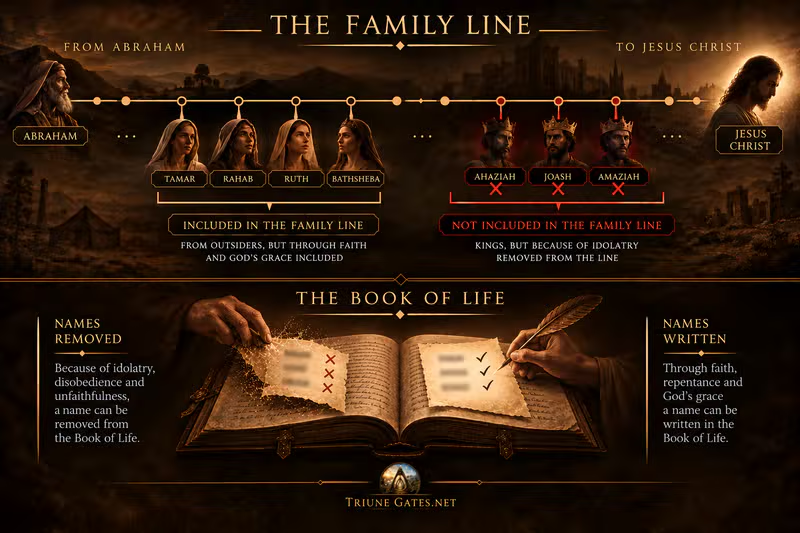
When comparing with 1 Chronicles 3, I kept thinking about the three omitted kings: Ahaziah, Joash and Amaziah.
All three became involved in idolatry. Joash and Amaziah at first did what was right, but later turned away from the LORD (2 Chronicles 22, 24 and 25).
In contrast stand Rahab and Ruth. They came from outside Israel, but turned precisely to the God of Israel. And their names were included in the genealogy of Jesus.
That brought me to a personal thought.
The three kings biologically truly belonged to the royal family. Yet their names are missing from the overview that Matthew gives us.
Could there be perhaps more in this than only a choice to bring the number of generations to fourteen?
Could it be that this written genealogy also contains a spiritual message, in which not only descent, but also the life path of people has meaning?
I was reminded of the Book of Life.
In Exodus 32:33 God speaks of blotting out a name from His book. And in Revelation 3:5 Jesus promises to the one who overcomes that He will not blot out his name from the Book of Life.
Paul also writes:
“For not all who are of Israel are Israel.”
Romans 9:6Is there perhaps a parallel?
Some stood outside the family of Israel and were included. Others belonged by birth to the royal family, but are missing from Matthew's written overview.
Perhaps this genealogy does not only tell us where people came from, but also makes us think about where their life path led them.
I cannot prove that Matthew skipped these three kings for spiritual reasons. After all, he also names other kings who sinned seriously. And from their absence we cannot deduce what their eternal destination was.
Yet I find the correspondence worth investigating.
For the Bible shows in many places that descent alone does not say everything. It is also about the heart, faith, repentance and perseverance.
Ruth 4 — A genealogy within a genealogy
At the end of the book of Ruth we find a series of names, from Perez to David (Ruth 4:18–22).
Those same names return in Matthew.
What in Ruth ends with David is continued in Matthew until Jesus Christ.
Three times fourteen generations
Matthew deliberately divides his overview into three periods:
- From Abraham to David.
- From David to the Babylonian exile.
- From the Babylonian exile to Christ.
In Matthew 1:17 he mentions three times fourteen generations.
Something striking has been discovered here: the Hebrew letters of the name David together have the numerical value fourteen: 4 + 6 + 4.
Perhaps Matthew wanted, with this arrangement, to place extra emphasis on Jesus as the Son of David. That is a well-known explanation, although Matthew himself does not say why he chose precisely these numbers.
When we compare his overview with 1 Chronicles 3, we also see that he does not name every generation. Between Joram and Uzziah, for example, three kings are missing: Ahaziah, Joash and Amaziah.
So Matthew evidently composed his genealogy deliberately. It is not intended as a complete listing of every biological generation.

The lost signet ring — Jeremiah 22 and Haggai 2
We find yet another remarkable connection with Jeconiah and Zerubbabel.
In Jeremiah 22:24–30 God compares King Jeconiah to a signet ring that He would pull from His hand. It is also announced that none of his descendants would prosper as king on David's throne.
But in Haggai 2:23 Zerubbabel, a descendant from the same royal line, is called by God His chosen signet ring.
The same image appears again, but now in a positive promise.
Zerubbabel did not become king; he was a governor. Therefore we cannot simply say that Jeremiah's judgment was undone.
Yet I find the correspondence remarkable: after the judgment the language of God's election sounds again.
3. What I have found
Promise, kingship, decline and restoration
For me an important key lies in the three periods that Matthew mentions.
- From Abraham to David: the promise and the rise of kingship.
- From David to Babylon: the crown and its loss.
- From Babylon to Christ: the coming of the promised King.
In this way a long list of names tells us, in just one chapter, a history of promise, kingship, decline and restoration.
Perhaps Matthew 1:17 is therefore not merely the conclusion of the genealogy, but precisely the key to understanding it.
The remarkable transition to Mary
Something else stands out in Matthew 1:16.
Again and again we read that one man fathered the next. But with Joseph the wording changes:
“And Jacob fathered Joseph, the husband of Mary, of whom was born JESUS, who is called Christ.”
Matthew does not say that Joseph fathered Jesus.
He calls Joseph the husband of Mary, of whom Jesus was born.
By this he prepares the reader for what he will tell in the following verses about Jesus' remarkable birth.
4. The reflection
A genealogy may seem a strange way to begin the New Testament.
But behind every name lies a human life.
There were people who trusted, people who doubted, people who failed seriously and people who turned precisely to God.
Kings lost their crown. A people was carried away into exile. Yet the promise to Abraham and David did not disappear.
And in the end Jesus Christ appears at the close of this long history.
What touches me in this is that God did not let go of His promises, in spite of everything people did wrong.
But the stories of these people also put a personal question to me:
For a good beginning is precious, but remaining faithful is at least as important.
5. Investigate for yourself
Read Matthew 1:1–17 alongside the following passages:
- Genesis 38, Joshua 2 and Ruth 4: why would precisely these women be named in the genealogy?
- 1 Chronicles 3 and 2 Chronicles 22–25: which kings are missing, and what do we know about their lives?
- Jeremiah 22:24–30 and Haggai 2:23: what does the image of the signet ring mean?
- Exodus 32:32–33, Romans 9:6 and Revelation 3:5: what do these texts tell us about descent, faithfulness and belonging to God's people?
And ask yourself one question:
Not every thought needs to become a fixed answer right away.
Sometimes a discovery begins precisely with careful reading, comparing and asking questions again.